 CK Core Motif
Bugfix Notes Archive 09
accessibility-action-count-bounds.md
Accessibility action-count bounds
The AT-SPI NActions property is a signed 32-bit D-Bus integer, while Motif
stores the action count as an unsigned value. The D-Bus adapter now saturates
counts above INT32_MAX before publishing them, instead of allowing a large
count to wrap into a negative property value.
Normal action counts are unchanged and the public Motif accessibility ABI is unchanged.
accessibility-child-index-bounds.md
Accessibility child-index bounds
Accessibility stores child indices as size_t but exposes signed int
positions to callers and transport notifications. Both index lookup and
removed-node notifications now use a saturating conversion, preventing large
trees from wrapping into negative or unrelated positions.
The focused source-contract regression is:
PYTHONDONTWRITEBYTECODE=1 python3 tests/automated/check-accessible-child-index-bounds.py
accessibility-dbus-child-count.md
Accessibility D-Bus child counts
The D-Bus accessibility bridge exposes child counts through an integer
protocol field. Native child storage uses size_t, so the bridge now clamps
counts above INT_MAX before conversion. Ordinary counts are unchanged and
large trees no longer wrap into negative or unrelated values.
accessibility-keysym-bits.md
Accessibility key-symbol wire values
AT-SPI device-event notifications carry the key identity in a signed 32-bit
field, while X11 KeySym values are unsigned. The accessibility D-Bus
adapter now copies the 32-bit key-symbol representation into that field
explicitly, preserving high-valued and Unicode keysyms without relying on an
implementation-defined signed cast.
The wire value for ordinary keysyms is unchanged.
accessibility-memo-capacity-bounds.md
Accessibility memo-table capacity bounds
memo_resize now validates its requested bucket capacity at the allocation
boundary, including the XtCalloc element-size conversion and the power-of-two
invariant required by the bucket bitmask. Invalid or overflowing capacities
fail before allocation, so future callers cannot rely on caller-side checks to
keep the memo table structurally valid.
The source-contract regression is
tests/automated/check-accessibility-memo-capacity-bounds.py.
accessibility-metadata-bounds.md
Accessibility metadata bounds
The public accessibility snapshot stores table dimensions and text positions
as signed int values because that is the width used by the AT-SPI protocol
methods. Motif's DataGrid counts and text APIs can use wider unsigned
quantities. The snapshot query therefore saturates values above INT_MAX
instead of narrowing them directly and turning them negative.
This keeps large or malformed widgets from publishing negative row counts, columns, text lengths, or caret offsets. Normal-sized widgets retain their exact values and the change does not alter the public ABI.
accessibility-name-allocation.md
Accessibility name allocation rollback
XmAccessibilityCreate now destroys its partially initialized state and
returns NULL when copying the application name fails. Valid names and the
public ABI are unchanged.
The static regression check is
tests/automated/check-accessibility-name-allocation.py.
accessibility-position-casts.md
Accessibility position casts
Accessibility selection ranges and visual-line offsets now use the shared
two-sided XmTextPosition clamp before filling their signed int outputs.
This keeps large or malformed provider positions from bypassing the boundary
guard and wrapping in the public accessibility API.
The focused source-contract regression is:
PYTHONDONTWRITEBYTECODE=1 python3 tests/automated/check-accessible-position-casts.py
accessibility-selection-count.md
Accessibility selection counts
List selection counts are stored as size_t internally but exposed through an
integer accessibility API. XmAccessibilitySelectionCount now uses the
shared saturating conversion helper, preventing implementation-defined
wraparound for an unusually large native selection set.
accessibility-text-navigation-bounds.md
Accessibility text-navigation bounds
Character navigation in the D-Bus accessibility adapter now computes
offset + direction in long long before clamping to the valid text range.
Offsets at INT_MAX or below zero therefore clamp correctly instead of
wrapping through signed int arithmetic.
The focused source-contract regression is:
PYTHONDONTWRITEBYTECODE=1 python3 tests/automated/check-accessible-text-navigation-bounds.py
accessibility-text-position-bounds.md
Accessibility text-position bounds
Accessibility exposes text positions through signed int fields. The
conversion helper now clamps both below INT_MIN and above INT_MAX, avoiding
implementation-defined narrowing for malformed or unusually large provider
positions.
The focused source-contract regression is:
PYTHONDONTWRITEBYTECODE=1 python3 tests/automated/check-accessible-text-position-bounds.py
accessibility-utf8-bounds.md
Accessibility UTF-8 conversion bounds
The locale-to-UTF-8 accessibility conversion checks both the wide-character
scratch allocation and the four-byte UTF-8 result bound before allocating.
The checks cover both size_t arithmetic and Xt's Cardinal allocation
interface, and both accepted sizes are passed explicitly at the allocator
boundary, so a representable host size cannot be truncated. Malformed or
unrepresentable input sizes therefore fail cleanly without
wrapping (count + 1) * sizeof(wchar_t). Allocation failures for either
scratch buffer also return cleanly without dereferencing a null pointer.
The converter rejects a NULL source before entering the multibyte state
machine.
The source-level regression is
tests/automated/check-accessible-utf8-bounds.py.
accessibility-value-initialization.md
Accessibility value initialization
Accessibility metadata is collected through public widget getters. Calendar, DatePicker, and TimePicker getters can reject a dead or invalid widget without initializing their caller-provided output structure. The accessibility bridge now publishes a value range only after that getter succeeds, so it never reads or exposes indeterminate date or time fields.
BreadcrumbBar and SegmentedControl likewise expose index ranges rather than raw unsigned counts. Empty controls retain their established neutral ranges, and large counts saturate before conversion to the accessibility int domain.
The focused source-contract regression is:
python3 tests/automated/check-accessible-value-initialization.py
additive-widget-contract.md
Additive widget contract
New controls are ordinary opt-in Motif widget classes. They use the existing Xt object, resource, geometry, traversal, callback, UIL/WML and display ownership rules; they do not introduce a parallel runtime or alter the meaning of an existing resource or callback record.
Public-class rules
- Each class gets a distinct public header, class symbol, constructor naming convention and resource/callback namespace.
- Resources describe persistent widget state. Per-view or transient state is not encoded in global variables or application-wide singletons.
- A widget owns its Xt children and cancels timers, work procedures and registered callbacks before destruction. Borrowed widgets are validated at the point of use and never retained past their owner’s lifetime.
- Geometry uses normal Xt negotiation. Explicit application dimensions win over fallback resources; scaled metrics are opt-in and must not reinterpret legacy pixel resources silently.
- Activation, value changes, cancellation and sensitivity have documented keyboard and pointer behavior. Typed callback records are added only when a generic callback cannot express the event without ambiguity.
- Callback-driven destruction is a required test case. No callback may require its widget or parent to remain alive after the callback returns.
Accessibility and UI-thread rules
Every class documents its accessible role, name/value/state exposure, actions, focus behavior and change notifications. Native accessibility providers consume those semantics; a provider’s absence does not change the widget’s state contract. All widget, display, resource and callback operations remain on the owning Xt thread. A new widget must not create worker threads or an animation loop; bounded Xt timers are permitted for visible indeterminate feedback and are canceled before unmap or destruction.
Delivery harness
tests/automated/run-additive-widget-contract.py compiles
check-additive-widget-contract.c against one absolute installed prefix,
checks that libXm and libXt resolve from that prefix, and runs the fixture
under an isolated Xvfb. The fixture deliberately uses existing public
PushButton/List classes as contract probes until WP-16 supplies the first new
class. It checks explicit-over-fallback resource precedence, keyboard focus
traversal, the public list accessibility-change callback, activation callback
teardown, and clean application-context shutdown.
The fixture is a contract gate, not a claim that every existing widget or an external assistive client is complete. A new class must add its own focused normal, invalid-input, resize, keyboard, accessibility and destruction cases.
aicon-c23-directory-safety.md
aicon directory-population safety
The historical aicon Container demonstration now uses typed C23 callback and
helper declarations. Its directory scanner no longer alters the caller's
file-selection text, bounds the assembled icon path and icon-list allocation,
closes the directory stream, and releases the temporary text returned by the
file-selection widget. Empty container selections are ignored safely before
trying to use their pixmap; failed pixmap geometry queries and empty directory
results no longer feed invalid values into the display or child-management
paths.
The focused source-contract check is:
python3 tests/automated/check-aicon-c23-directory-safety.py
animate-c23-callbacks.md
Animate demo C23 callbacks
The Animate demonstration keeps its existing Mrm callback registration and animation behavior, but its application entry point, work procedure, and UI callbacks use exact typed C declarations rather than legacy K&R definitions or unspecified forward declarations. This makes the demo build with the current C23 configuration without changing its UID interface.
The focused source-contract check is:
python3 tests/automated/check-animate-c23-callbacks.py
appearance-draw-gc.md
Shared appearance drawing GC failures
The modern button focus, button face, and cascade-indicator helpers allocate short-lived X graphics contexts. Each helper now treats that allocation as fallible. Button helpers release their temporary clipping region before returning; cascade indicators simply skip that paint pass. No public resource, widget state, or rendering contract changes, and a later expose retries the draw normally.
The focused source-contract regression is
tests/automated/check-appearance-draw-gc.py.
appearance-profile-number-overflow.md
Appearance-profile numeric overflow
Appearance-profile dimension and metric values now reject strtoul()
conversion overflow before the result is narrowed to Dimension. This keeps
out-of-range resource values from becoming a platform-dependent maximum size.
The focused source-contract check is:
python3 tests/automated/check-appearance-profile-number-overflow.py
appearance-snapshot-bounds.md
Appearance transaction snapshot bounds
Appearance-profile changes snapshot all live widget states before preparing a
transaction. The snapshot count is tracked in native size_t, rather than
wrapping through the public Cardinal type, and the snapshot plus its
per-widget change plans reject a count that cannot fit both the XtMalloc
Cardinal argument and native allocation arithmetic. The transaction returns
failure before taking any state references; valid transactions are unchanged.
After that validation, the allocation is explicitly narrowed to Xt's accepted
byte-count type.
The modern arrow inset helper also clamps its position updates to the X11
Position range, so large allocated cells cannot wrap the arrow origin.
The helper also treats a missing widget or geometry pointer as a no-op before
consulting display/profile state.
The focused source-contract check is:
python3 tests/automated/check-appearance-snapshot-bounds.py
arrow-button-gadget-redisplay-guards.md
ArrowButtonGadget redisplay guards
XmArrowButtonGadget can be exposed while its manager resources are being
replaced or while highlight and shadow margins leave no drawable area. Its
background, shadow, and arrow helpers previously accepted missing GCs and
zero-sized geometry.
The redisplay and shared arrow helper now skip only invalid intermediate requests. Input-driven arm and activate redraws use the same safe helper, while valid gadget rendering and callback behavior remain unchanged.
arrow-button-redisplay-guards.md
ArrowButton redisplay guards
XmArrowButton can receive an expose event while its resources are being
replaced or after a resource allocation has failed. Redisplay now checks the
shadow and arrow GCs before passing them to the X drawing helpers. The arrow
geometry helper also returns for zero-sized bounds, which avoids issuing
invalid drawing requests when highlight and shadow margins consume the whole
widget.
Classic rendering remains unchanged when the required resources and geometry are available. The superclass expose handler is still invoked so standard Xt event processing continues for partially initialized widgets.
Modern arrow bounds
Modern light and dark profiles center the arrow within the content rectangle, after excluding the control's focus and shadow margins. The glyph is at most 18 logical pixels in comfortable density or 16 in compact density, with at least four logical pixels of surrounding padding. Small allocations shrink the glyph; allocations with no remaining content draw no arrow. Display scaling is applied once. Widget and gadget variants use the same geometry rule.
Modern light and dark profiles use a shared renderer for ArrowButton and ArrowButtonGadget: a flat rounded frame and an open chevron centered within the content rectangle. The chevron spans at most 14 logical pixels, with at least four logical pixels of padding inside the frame. Small allocations shrink the glyph; allocations without sufficient content draw no arrow. Round line caps are included in the glyph bounds. Display scaling is applied once.
The frame defaults to one logical pixel. Its color comes from
XmNbottomShadowColor; explicit application colors and thicknesses remain
authoritative. Modern palette defaults provide a visible border on both light
and dark surfaces. Pressed controls invert their foreground/background colors;
disabled controls use the subdued border color for the glyph. Each state
transition repaints the full face, while the existing focus rendering remains
outside it. Classic and high-contrast use their existing arrow/bevel renderer.
Modern Forms and BulletinBoards default to no shadow: layout containers should not introduce a bevel around their children. Explicit shadow resources still take precedence. Classic and high-contrast profiles retain their own defaults.
tests/automated/run-arrow-bounds.py runs an installed-library regression that
reads the actual X pixels for all four directions, both widget types, light and
dark profiles, both densities, and 1×, 1.5×, 2× and 3× scales. It checks enabled
and disabled controls, tiny allocations, and default/explicit container shadows.
tests/automated/run-modern-arrows.py checks native frame/glyph pixels and
arm, leave, re-enter and activate behavior in 96 cases per font configuration.
It also verifies live classic/modern transitions and explicit frame thickness.
Pointer-inside state is retained separately from the armed state, so an expose
after dragging outside does not redraw the control as pressed. The regression
forces that repaint for widget and gadget controls and checks the same behavior
in classic and high-contrast profiles.
Preferred target size
The widget and gadget report the same preferred square target. Modern defaults are 36 logical pixels in comfortable density and 28 in compact density, enlarged when explicit focus/frame widths need more room around the chevron. Classic and high-contrast retain their 15-pixel content extent plus focus and shadow margins.
Unspecified axes follow toolkit metrics during profile, density and scale changes. Explicit nonzero dimensions remain application-owned; if a parent subsequently changes that allocation, appearance changes retain the parent's current size. Setting an axis to zero returns it to natural sizing. Resource-file dimensions follow the same rules. QueryGeometry reports the natural target even when a parent or application has constrained the actual allocation.
tests/automated/run-arrow-sizing.py exercises these ownership rules across
profiles, densities, scales and both control types. The gallery relies on this
toolkit geometry and supplies only the arrow direction.
Disabling during a pointer gesture
An arrow press is canceled when either the control or an ancestor becomes insensitive. Re-enabling does not restore the pending press. A fresh press is required before a release can activate the arrow, including repeated clicks. The widget and gadget share this rule in all appearance profiles.
The native modern-arrow fixture checks local and ancestor cancellation for both control types, including unchanged normal activation after cancellation. The NumberBox editing fixture dispatches actual pointer translations and covers release outside, disabled input, cancellation during a press, range boundaries, wrapping and destruction of the composite from the step callback.
arrow-geometry-allocation.md
Legacy arrow geometry allocation
The legacy arrow geometry builder now allocates its top, center, and bottom rectangle arrays transactionally. If any allocation fails, all partial arrays are released and the output pointers remain cleared after the existing cache reset; successful geometry is unchanged. Null count or output pointers are rejected before the existing rectangle cache is touched.
The focused regression check is
tests/automated/check-arrow-geometry-allocation.py.
atom-list-conversion.md
Atom-list resource conversion
XmRAtomList conversion now checks temporary name-array growth and the final
atom-array size before multiplying allocation counts. If a malformed resource
would exceed representable storage, all token strings and temporary arrays are
released and conversion fails cleanly. Accepted name-array and atom-array byte
counts are passed explicitly as Xt Cardinal values.
The source-level capacity regression is
tests/automated/check-atom-list-bounds.py.
auto-suggest-box.md
AutoSuggestBox
XmAutoSuggestBox is an opt-in composite containing an ordinary
XmSearchBox and an anchored native scrolled XmList popup. The application owns the
provider, filtering, I/O and UI-thread scheduling. The toolkit never calls a
provider from drawing or popup layout code.
Every query change increments a monotonically increasing generation and sends
that generation with XmNautoSuggestQueryChangedCallback. The application
must pass the same generation to XmAutoSuggestBoxSetSuggestions; older or
future generations are rejected, so a delayed result cannot replace a newer
query. The widget copies suggestion IDs and labels and retains user_data
without taking ownership. The complete replacement is prepared before discarding
previous results; invalid counts or allocation failure leave the previous model
intact. Compound-string label renditions are preserved. Committing a suggestion
invalidates outstanding queries through the generation counter without issuing
another provider query for the committed text.
Down-arrow moves focus from the search field to the popup list. Escape dismisses
it and returns focus to the field. Tab and Shift+Tab dismiss without committing
and move to the next or previous tab group relative to the field in its owning
window. They do not cycle inside the popup shell. The list's normal
keyboard/pointer activation commits the selected item through
XmNautoSuggestCommittedCallback and returns focus to the field. Dismissal is
reported separately; focus moving elsewhere is preserved. An empty accepted
result is shown as the configurable no-results label and is never actionable.
The popup is per-widget and is destroyed with its owner; no global suggestion
state or blocking work is introduced.
The composite takes its preferred dimensions from the native search field. Explicit width and height constrain their axes independently; setting an axis to zero restores natural sizing. The popup aligns with the painted field frame, excluding its focus gutter, shows at most eight result rows and uses native scrollbars for overflow. It opens below the field when space permits, otherwise above when that side offers more room, and remains within screen bounds. Ancestor configure events reposition it; unmapping the anchor dismisses it. Results supplied before realization wait until the field is viewable before opening the popup.
Callbacks may destroy the owner. Notification snapshots stop at destruction; query and selected-ID strings remain valid throughout each dispatch. A text verification veto suppresses commit. The widget owns a copy of the no-results label, and tracks child/popup destruction to avoid stale teardown pointers. The gallery demonstrates an actual case-insensitive provider, including empty results, using the callback's current generation and native sizing.
Disabling the control or an ancestor cancels the popup and any pending list gesture. Re-enabling before the event loop runs does not revive that gesture or permit a pending commit. Dismissal notification runs after the resource update returns; destruction removes the pending notification. Provider results may still update the model while disabled but cannot reactivate the list. The underlying List cancellation behavior keeps releases from reviving a cancelled selection. Showing the popup again is an explicit action after cancellation has completed.
run-autosuggest-native.py covers natural geometry, screen-edge placement,
bounded scrolling, stale/oversized result rejection, Escape, native pointer
commit, verification vetoes, no-results ownership, unmapping and destruction
from query, commit, dismissal, inherited text and native list notifications.
Component demo
Captured gallery example and its corresponding source excerpt.
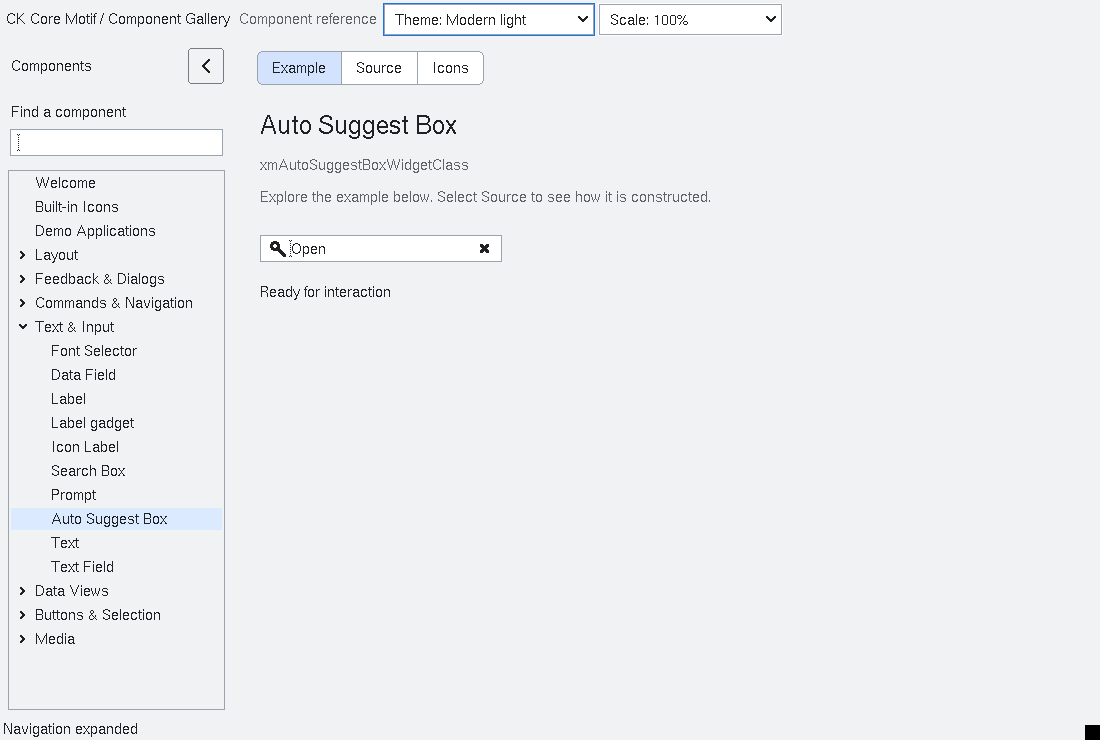
Actual gallery excerpt: class = xmAutoSuggestBoxWidgetClass. The host supplies parent, name, callback and client_data. Shared factory locals: Widget example; XmString label = NULL. The shared factory frees label, attaches callbacks and sizes the preview. Helpers and the complete factory are in gallery_examples.c.
static Boolean gallery_suggestion_matches(const char *label, const char *query)
{
    if (!*query) return True;
    for (; *label; ++label) {
        size_t i = 0;
        while (query[i] && label[i] &&
               tolower((unsigned char)query[i]) == tolower((unsigned char)label[i])) ++i;
        if (!query[i]) return True;
    }
    return False;
}
static void gallery_suggestions(Widget widget, XtPointer closure, XtPointer data)
{
    static const char *const names[] = {"Open document", "Open folder", "Open recent"};
    static const char *const ids[] = {"document", "folder", "recent"};
    XmAutoSuggestCallbackStruct *query = data;
    XmAutoSuggestItem items[3];
    Cardinal count = 0;
    (void)closure;
    for (Cardinal i = 0; i < XtNumber(names); ++i) {
        if (!gallery_suggestion_matches(names[i], query->query)) continue;
        items[count].id = ids[i];
        items[count].label = XmStringCreateLocalized((char *)names[i]);
        items[count].user_data = NULL;
        ++count;
    }
    XmAutoSuggestBoxSetSuggestions(widget, items, count, query->generation);
    for (Cardinal i = 0; i < count; ++i) XmStringFree(items[i].label);
}
example = XtVaCreateManagedWidget((char *)name, class, parent, NULL);
XtAddCallback(example, XmNautoSuggestQueryChangedCallback, gallery_suggestions, NULL);
XmSearchBoxSetString(XmAutoSuggestBoxGetSearchField(example), "Open");
Focus leaving the field and suggestion popup dismisses the popup after native traversal settles. Movement between the field and popup keeps it open. The popup uses a traversal-capable transient shell with override-redirect placement; it remains nonmodal. A deferred check resolves actual X input focus before consulting the owning shell's logical focus, avoiding stale focus in another window. The owner cancels that check during destruction. While open, the popup observes button presses on the application's native widgets on the same display, including widgets and shells created later. An outside press dismisses without consuming or replaying the event, even when keyboard focus stays on the search field. Presses within the field or popup remain part of their native interaction. Observers are removed on dismissal, widget destruction, and owner teardown. This uses no global pointer grab: input sent to a different X client is handled through focus loss, not by intercepting that client's events.
avatar-xrender-mask-allocation.md
Avatar XRender mask allocation bounds
Modern Avatar rendering constructs an A8 XRender coverage mask only for a
positive, bounded diameter. After Xlib creates the temporary XImage, Avatar
also verifies that its row stride is positive and that the requested rows fit
the allocation domain before assigning image data.
An unsupported image layout now falls back to the existing non-XRender drawing path rather than allocating through a signed or overflowing stride. The normal circular image and initials rendering path is unchanged.
Regression: tests/automated/check-avatar-pixmap-allocation.py.
baseclass-resource-copy-allocation.md
BaseClass resource-copy allocation guards
When a composite widget class has an uncompiled resource list,
BaseClass.c copies the list into Xt-owned storage. The copy now checks both
native size_t multiplication and the Xt Cardinal limit before allocating,
so a representable host size cannot silently truncate on Xt’s allocation API.
The focused source-contract check is
tests/automated/check-baseclass-resource-copy-allocation.py.
breadcrumb-bar-redisplay-guards.md
BreadcrumbBar redisplay guards
XmBreadcrumbBar now handles a missing drawing GC, null separator or segment
labels, and narrow focus geometry without invalid Xlib calls or unsigned
underflow. Item drawing also skips XmStringDraw when the render table could
not be initialized, matching the existing safe sizing fallback. Normal
segment sizing and navigation remain unchanged.
The focused source contract is checked by
tests/automated/check-breadcrumb-bar-redisplay-guards.py.
breadcrumb-bar.md
BreadcrumbBar
XmBreadcrumbBar is an additive, resource-driven path presentation. The
application owns each segment's label and opaque id; XmBreadcrumbBarSetSegments
copies labels while retaining IDs for callback delivery. The widget never
parses paths or navigates on its own.
XmNbreadcrumbMaxVisible enables bounded leading-ellipsis collapse, and
XmNbreadcrumbRtl changes the visual and keyboard direction without changing
the logical segment order. Left/right keys move the current segment and
Return activates it. Pointer selection and activation use the same callbacks.
These user-input paths are inactive while the BreadcrumbBar or an ancestor is
insensitive; applications may still set the current segment explicitly.
XmNbreadcrumbCurrentChangedCallback reports selection changes and
XmNbreadcrumbActivateCallback reports an explicit activation. Callback data
is an XmBreadcrumbBarCallbackStruct; the id is the application-owned
payload and must remain valid until the callback returns. No callback runs
from drawing or geometry negotiation.
The control has no global popup, path model, or external URL behavior. Empty segments are allowed and are rendered as empty labels. Existing Button, Label, Menu and List contracts are unchanged.
Component demo
Captured gallery example and its corresponding source excerpt.
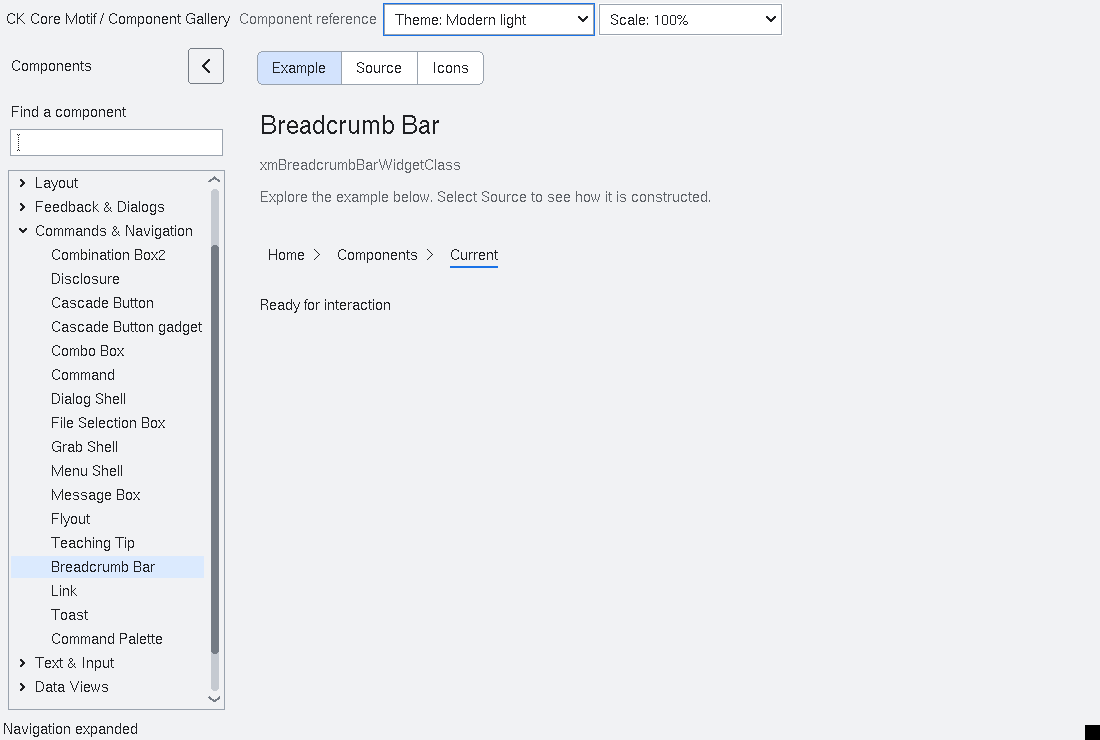
Actual gallery excerpt: class = xmBreadcrumbBarWidgetClass. The host supplies parent, name, callback and client_data. Shared factory locals: Widget example; XmString label = NULL. The shared factory frees label, attaches callbacks and sizes the preview. Helpers and the complete factory are in gallery_examples.c.
XmBreadcrumbSegment segments[3] = {
    {"Home", (XtPointer)"home"},
    {"Components", (XtPointer)"components"},
    {"Current", (XtPointer)"current"}
};
example = XtVaCreateManagedWidget((char *)name, class, parent, NULL);
XmBreadcrumbBarSetSegments(example, segments, 3);
XmBreadcrumbBarSetCurrentIndex(example, 2, False);
Modern presentation
An unset (NULL) XmNbreadcrumbSeparator selects the profile's automatic
separator: a directional chevron in Modern Light/Dark and / in Classic.
An explicit string, including / or an empty string, remains authoritative.
Setting the resource back to NULL restores automatic separators. Chevron
size and spacing follow display scale; RTL mirrors the direction.
Modern mode reports the complete measured natural width and a font-aware height, with room for its indicator. Explicit widget dimensions remain authoritative. Modern mode keeps the current label on the normal bar background with a subtle accent underline. Classic retains its inverted current-item treatment. Rendering refreshes GC colors from the active resources on every frame, and modern item widths and hit tests share the visual-leading segment rule so RTL labels and separators use consistent space. No callback, ID or selection semantics or public widget-record layout changes.
tests/automated/run-breadcrumb-modern.py --build ABS_BUILD --results ABS_NEW_DIR
runs a native Xvfb rendering and input regression across repeated Classic,
Modern Light/Dark, 100/150/200% scale and LTR/RTL transitions. It checks the plain
current-item surface, accent pixels, custom separators, quiet theme changes,
keyboard traversal and pointer activation. The existing BreadcrumbBar contract
and source guards remain part of acceptance.
breadcrumb-count-range.md
BreadcrumbBar segment-count range
XmBreadcrumbBarSetSegments accepts a Cardinal count, while the current
segment is stored and exposed through a signed int. Counts above INT_MAX
would make the count - 1 current-index conversion unrepresentable. The
setter now rejects those counts before freeing or replacing existing items;
all representable counts retain their existing behavior.
The regression contract is checked by
tests/automated/check-breadcrumb-count-range.py.
bulletin-board-shadow-redisplay-guards.md
BulletinBoard shadow redisplay guards
XmBulletinBoard redraws its manager shadow after redisplaying child gadgets.
The expose path previously assumed a realized window, valid shadow GCs, and
non-zero dimensions whenever shadow thickness was configured.
The shadow request now waits for those prerequisites. Gadget redisplay and cached geometry updates still run, and valid realized boards retain their existing shadow type and dimensions.
cache-geometry-status.md
Pixmap-cache geometry status
When dimensions were omitted, _XmCachePixmap ignored the status returned by
XGetGeometry. Invalid server-side pixmap handles could therefore leave
uninitialized width, height, and depth values in the cache.
The query is now required to succeed before cache allocation. Failed geometry
lookup returns False without creating an entry.
tests/automated/check-cache-geometry-status.py protects this contract.
cache-pixmap-input.md
Pixmap-cache input validation
_XmCachePixmap queries geometry immediately when dimensions are omitted.
Passing a null screen or the unspecified pixmap handle therefore reached Xlib
with invalid arguments.
The API now rejects either invalid handle before initializing cache state or issuing X requests. Existing valid pixmap caching and geometry behavior are unchanged.
tests/automated/check-cache-pixmap-input.py protects this boundary.
calendar-geometry-guards.md
Calendar geometry and callback guards
XmCalendar now handles missing drawing GCs, clamps selected-day geometry, and
avoids zero-width cell division in pointer handling. Callback routing compares
resource names by content, so activation and date-change callbacks remain
separate even when callers provide equivalent strings.
Calendar metric sampling now only frees an XmString after successful
creation. A missing render table still uses the existing fallback dimensions,
while a successfully created sample is always released.
The focused source contract is checked by
tests/automated/check-calendar-geometry-guards.py.
callback-allocation-failure.md
Callback-list allocation failure
Internal Motif callback lists can be copied or resized while callbacks are being called. Allocation failure is now handled transactionally: adding a callback leaves the active list intact, and removing a callback preserves the current list when a replacement cannot be allocated. Deferred-free state is also cleared when a copy cannot be made, preventing a dangling callback-list pointer after callback dispatch completes.
The focused regression check is
tests/automated/check-callback-allocation-failure.py.
callback-capacity.md
Callback-list capacity bounds
Motif's internal callback list stores its entry count in an unsigned short.
_XmAddCallback now refuses to grow a list at that representational limit,
and checks the header-plus-entry byte count before either allocation path.
This prevents count wraparound and keeps the callback array within Xt's
allocation-width contract while preserving normal callback behavior.
cardinal-item-bounds.md
Cardinal item-list allocation bounds
The public breadcrumb and segmented-control setters accept Xt Cardinal
item counts. Their item arrays now check both size_t multiplication and the
Xt Cardinal byte-width limit before allocation, preventing truncation on
32-bit Xt builds while retaining the existing False/empty-state failure
behavior.
cascade-button-appearance.md
Cascade button appearance
Modern light and dark profiles give XmCascadeButton and
XmCascadeButtonGadget flat surfaces, theme selection colors, modern render
tables and density-aware padding. Default padding is 12 by 6 logical pixels
in comfortable density and 8 by 3 in compact density. The default shadow is
zero; application-supplied thicknesses and colors remain authoritative.
The internal resource-ownership query includes live gadgets, using their
Object destruction callbacks to retire state before addresses can be reused.
Arming, disarming and exposure repaint the complete surface so selection does
not leave a legacy bevel or stale gray rectangle.
Generated submenu arrows use clean directional chevrons. Right-to-left menus reverse their disclosure direction; option-menu gadget arrows point down. Application-supplied cascade pixmaps retain their existing drawing behavior. Compound strings, label pixmaps, accelerators and mnemonics continue through the ordinary Label renderer. Classic and high-contrast profiles retain their existing drawing paths, and returning to Classic restores toolkit defaults. No public resources or native instance records change.
Cascade controls belong in a menu RowColumn, such as a menu bar, pulldown or
popup. Use XmCreateMenuBar, create the pulldown from that bar, then create the
cascade as a child of the bar with XmNsubMenuId referencing the pulldown.
Modern menu bars default to zero outer shadow; explicit application shadows
remain authoritative. The gallery reuses its supplied menu bar; the shared
example factory creates one only when given a generic host. Both host paths
are covered by native tests.
Native qualification uses the actual gallery factory:
python3 tests/automated/run-cascade-appearance.py \
  --build /absolute/build --results /absolute/fresh-results
The test runs on an isolated display and exercises both classes, live palettes, scale and density changes, selected/unselected pixels, explicit application resources, action callbacks and repeated destruction/recreation. It sends no input to the user's desktop.
cascade-button-gadget-shadow-redisplay-guards.md
CascadeButtonGadget shadow redisplay guards
XmCascadeButtonGadget draws its shadow into the realized manager window.
During manager realization, resource replacement, or narrow gadget geometry,
its parent window, shadow GCs, and rectangle can be incomplete.
The armed and option-menu shadow path now requires a realized parent, both shadow GCs, non-zero shadow thickness, and geometry larger than the highlight margins. Valid gadget rendering and menu behavior remain unchanged.
cascade-button-shadow-redisplay-guards.md
CascadeButton shadow redisplay guards
An armed XmCascadeButton draws a 3D shadow around its label. The old path
only checked realization, so an intermediate resource replacement or narrow
geometry could pass missing GCs or underflowed dimensions to
XmeDrawShadows.
The armed path now requires both shadow GCs, non-zero shadow thickness, and a rectangle larger than its highlight margins. Menu etched-in selection and all other cascade behavior are unchanged when the widget is valid.
cascade-resource-bounds.md
CascadeButton resource-table bounds
CascadeButton class initialization checks the combined superclass and subclass
resource counts before allocating the merged XtResource table, and checks the
allocation before populating it. An unrepresentable or unavailable table
leaves initialization without wrapping its count or dereferencing null state;
normal resource merging is unchanged.
The source-level regression is
tests/automated/check-cascade-resource-bounds.py.
cascadebg-resource-merge.md
CascadeButton resource-list merge guards
CascadeButton class initialization merges the LabelG and CascadeButton
resource arrays into one Xt resource list. The existing native size_t check
now also enforces Xt's Cardinal limit before the merged list is allocated,
keeping the class initialization safe on platforms where those widths differ.
The focused source-contract check is
tests/automated/check-cascadebg-resource-merge.py.
charset-canonicalization-bounds.md
Charset canonicalization bounds
The private charset canonicalizer accepts application-derived strings. Its legacy ISO detection path assumed a non-null pointer and used an unbounded format write into a fixed-size canonical name buffer.
Null input now returns NULL safely, and the fixed ISO form uses bounded
formatting. Existing ASCII, ISO, and pass-through canonical names are
unchanged.
tests/automated/check-charset-canonicalize-bounds.py protects these paths.
charset-canonicalize-allocation.md
Legacy charset canonicalization allocation
The compatibility charset canonicalization helper now checks allocation for
ASCII, ISO, and pass-through charset results before writing the output string.
On allocation failure it returns NULL, matching the helper's existing
failure contract without changing successful canonicalization.
The focused regression check is
tests/automated/check-charset-canonicalize-allocation.py.
charset-conversion-state-inputs.md
Charset conversion state inputs
The compound-text charset helpers now reject a missing charset tag or output state before comparing tags or appending converted data. This protects both the narrow and UTF-8 conversion paths from malformed XmString component streams while preserving valid conversion behavior.
Regression coverage: tests/automated/check-charset-conversion-state.py.
chip-label-destroy.md
Chip label destruction
XmChip copies its label XmString during initialization and replacement.
The widget now releases that owned copy in Destroy, preventing label storage
from accumulating across repeated chip creation and destruction.
clip-window-translation-inputs.md
ClipWindow translation inputs
The private ClipWindow translation builder now rejects a missing display, missing key-binding array, or non-positive key count before indexing the array or asking X11 to resolve keysyms. This also prevents a negative signed count from being compared against the unsigned traversal index and becoming a large out-of-bounds walk.
Invalid input returns the existing reusable empty translation buffer, so the
normal widget initialization contract remains fail-closed and ABI-compatible.
The focused source regression is
tests/automated/check-clip-window-translation-inputs.py.
clip-window-translations.md
ClipWindow translation-buffer growth
Virtual-key translation assembly now handles an empty initial capacity, checks
XtRealloc before publishing the replacement, and aborts cleanly when the
initial buffer or a growth allocation fails. The previous zero-capacity path
could loop forever, while a failed growth could lose the live buffer before a
write.
tests/automated/check-clip-window-translation-allocation.py protects these
contracts.
clipboard-callback-snapshot-guard.md
Guard deferred clipboard snapshot callbacks
Deferred clipboard callbacks can arrive after their snapshot association has already been removed during cancellation or widget teardown. The callback now checks its data identifier, dictionary, and snapshot record before decrementing or dereferencing the record, returning cleanly when the association is gone.
The focused source regression is
tests/automated/check-clipboard-callback-snapshot-guard.py.
clipboard-callback-table-growth.md
Clipboard callback table growth
Cut-by-name callbacks use paired callback and item-id tables. XmClipboardStartCopy
now grows those tables with checked allocate-copy-swap logic. A failed
allocation leaves the existing pair untouched, releases the temporary item and
clipboard lock, restores the previous header state, and returns
ClipboardFail; successful callback registration remains unchanged.
clipboard-cancel-copy-validation.md
Clipboard cancel-copy validation
XmClipboardCancelCopy now validates the next-id property before restoring it
and checks the clipboard header before changing its copy state. Missing,
failed, or undersized properties release the clipboard lock and return
ClipboardFail without dereferencing invalid storage.
clipboard-close-size-guard.md
Clipboard header close size guard
ClipboardClose now ignores null headers and rejects currItems values whose
serialized header size would overflow unsigned long. This prevents malformed
clipboard state from wrapping the property length or dereferencing a null
header during cleanup.
clipboard-convert-allocation.md
Clipboard conversion allocation handling
The clipboard selection conversion path now checks the data buffer length
against Xt's Cardinal allocation width before allocating storage for
non-built-in targets. Allocation failure or an oversized length returns a
failed conversion with no output buffer. If retrieval fails after allocation,
the temporary buffer is released and the output pointer and size are cleared,
preventing a leak and avoiding exposure of an invalid result.
clipboard-copy-allocation.md
Clipboard copy allocation failure handling
XmClipboardCopy now checks allocations for newly created format records and
their data buffers before publishing the item update. It also checks the
status and returned buffer from existing-format retrievals before appending.
Failures release temporary storage and clipboard locks and return
ClipboardFail (or the underlying retrieval status), avoiding null-pointer
dereferences and partially published records. Successful copies, including
zero-length and pass-by-name copies, retain their existing behavior.
clipboard-copy-by-name-validation.md
Clipboard copy-by-name validation
XmClipboardCopyByName now validates the clipboard header, format record, and
format-data retrieval before dereferencing or appending data. Invalid results
release temporary records and any acquired lock and return ClipboardFail.
Zero-length copy-by-name operations remain valid without pointer arithmetic on
a null data buffer.
clipboard-copy-id-validation.md
Clipboard copy ID validation
XmClipboardCopy now checks the clipboard header and both newly allocated
format IDs before linking or publishing a format record. A failed ID
allocation releases the temporary format/item records and clipboard lock
without publishing partial state.
clipboard-copy-input-validation.md
Clipboard copy input validation
XmClipboardCopy now rejects missing format names and null non-empty data
buffers. XmClipboardCopyByName rejects null non-empty data buffers as well.
Both return ClipboardBadFormat before clipboard state changes; valid and
zero-length copy operations remain compatible.
clipboard-data-ready-validation.md
Clipboard data-ready event validation
ClipboardDataIsReady now rejects missing event/private state and validates
the retrieved format record before reading its cut-by-name flag. Invalid
records are released and reported as not ready instead of invoking fatal
corruption handling or dereferencing malformed storage.
clipboard-data-wait-cleanup.md
Clipboard cut-by-name wait cleanup
ClipboardRequestDataAndWait now restores the root-window event mask on every
early failure path. It also refuses to create an Xt timeout when the request
window cannot map to a widget/application context, avoiding a null-context
event-loop call.
clipboard-delete-formats-validation.md
Clipboard delete-formats validation
ClipboardDeleteFormats now validates the data-item record, format-list
offset/count bounds, and every retrieved format record before iterating or
reading fields. Malformed records are released and ignored without fatal
corruption handling or out-of-bounds list traversal.
clipboard-delete-label-validation.md
Clipboard delete-label validation
ClipboardDeleteItemLabel now validates the data-item lookup status and
minimum record length before reading the label ID. Missing or malformed items
are released and ignored instead of entering fatal corruption handling.
clipboard-delete-state-validation.md
Clipboard delete-state validation
ClipboardIsMarkedForDelete now validates the item ID, lookup status, and
data-item record length before reading deletePendingFlag. Invalid items are
released and treated as unmarked, allowing deletion scans to fail closed
without fatal corruption handling.
clipboard-end-copy-header-guard.md
Clipboard end-copy header guard
XmClipboardEndCopy now checks the header returned by ClipboardOpen before
reading its copy state. If header retrieval fails, the operation releases the
clipboard lock and application mutex and returns ClipboardFail; successful
copy finalization is unchanged.
clipboard-end-copy-record-validation.md
Clipboard end-copy record validation
XmClipboardEndCopy now validates the finalized data-item retrieval status,
pointer, and record length before reading cut-by-name fields. Invalid records
are released and follow the existing corrupt-clipboard handling instead of
being dereferenced as a shorter or missing structure.
clipboard-event-record-validation.md
Clipboard event record validation
Clipboard client-message handling now validates retrieved format records and header records before dereferencing them, including minimum record lengths and callback-index bounds. It also releases records when callback state is absent. Malformed or incomplete properties are ignored without invoking an invalid callback or corrupting clipboard state.
clipboard-format-atom-allocation.md
Clipboard format-atom allocation handling
ClipboardGetAtomFromFormat now rejects a null format name, checks the
synthetic atom-name size for overflow, and checks its allocation before
formatting. Any failure returns None, allowing callers to fail closed rather
than dereferencing an invalid temporary string.
clipboard-format-buffer-validation.md
Clipboard format buffer validation
XmClipboardInquireFormat now rejects a null output buffer when a nonzero
buffer length is requested, returning ClipboardBadFormat before clipboard
locking or copying. Zero-length inquiries and valid buffers retain their
existing behavior.
clipboard-format-length-validation.md
Clipboard format-length validation
ClipboardGetLenFromFormat now rejects failed or malformed format properties
before reading their payload. The synthetic format atom must exist, and the
property must be a non-empty X11 format-32 result; otherwise the helper
returns ClipboardFail with the existing default length of 8 bits.
clipboard-header-validation.md
Clipboard header validation
ClipboardOpen now rejects short or null clipboard-header properties before
callers access header fields. A malformed header property is removed and a
fresh default header is retrieved, preserving normal clipboard recovery while
avoiding out-of-bounds header reads.
clipboard-inquire-count-header-guard.md
Clipboard inquire-count header guard
XmClipboardInquireCount now checks the header returned by ClipboardOpen
before reading retrieval timestamps or querying item lists. Header failure
releases the clipboard lock and application mutex and returns ClipboardFail.
clipboard-inquire-format-guards.md
Clipboard format inquiry guards
XmClipboardInquireFormat now rejects a null outlength pointer before
locking and checks the clipboard header before using its retrieval state.
Invalid calls return ClipboardBadFormat; header retrieval failure releases
locks and returns ClipboardFail.
clipboard-inquire-format-zero-length.md
Clipboard format inquiry zero-length results
XmClipboardInquireFormat now skips the destination copy when the effective
buffer length is zero. This keeps the supported buffer == NULL, bufferlength == 0 query form safe while preserving truncation and normal
non-empty copies.
clipboard-inquire-length-guards.md
Clipboard length inquiry guards
XmClipboardInquireLength now rejects a null format name before calling X11
atom APIs and checks the clipboard header before accessing retrieval state.
Header failure releases the clipboard lock and application mutex; the optional
length output remains optional as before.
clipboard-inquiry-lock-cleanup.md
Clipboard inquiry lock cleanup
Clipboard inquiries now close their temporary header and release the clipboard
lock when an external selection cannot provide data. This applies to format
count, format-name, and format-length inquiries, allowing subsequent clipboard
operations to retry instead of remaining locked after ClipboardNoData.
clipboard-inquiry-result-validation.md
Clipboard inquiry result validation
Clipboard inquiries now reject inconsistent external-selection results where a
nonzero byte count is paired with a null allocation pointer. Count, format,
and length inquiries release their header and lock before returning
ClipboardNoData, preventing malformed selection data from becoming an atom
array or format string.
clipboard-item-id-allocation.md
Clipboard item-ID allocation validation
ClipboardGetNewItemId now validates the next-ID property before incrementing
or replacing it. XmClipboardStartCopy also aborts cleanly if either the item
or label ID cannot be allocated, restoring the previous header state and
releasing resources.
clipboard-lock-allocation.md
Clipboard lock allocation
The Motif clipboard lock path allocates a small lock record when no lock
property exists. Allocation failure is now reported as ClipboardFail after
releasing the application lock, before the record is initialized. Existing
clipboard ownership and lock-level behavior is unchanged for successful
allocations.
The focused regression check is
tests/automated/check-clipboard-lock-allocation.py.
clipboard-mark-item-validation.md
Clipboard mark-item validation
ClipboardMarkItem now validates data-item lookup status and record length
before setting deletePendingFlag. Missing, failed, or undersized records are
released and ignored instead of entering fatal corruption handling or being
dereferenced as a full structure.
clipboard-next-id-validation.md
Clipboard next-id validation
ClipboardOpen now validates the _MOTIF_CLIP_NEXT_ID property returned from
the root window. A null or undersized value is discarded and replaced with the
standard first-free item ID, keeping subsequent clipboard allocations
consistent after malformed external state.
clipboard-next-item-guard.md
Clipboard next-item update guard
ClipboardSetNextItemId now checks the result of retrieving the next-item
property before writing through it. Missing, failed, or undersized properties
are released and ignored, avoiding a null or short-buffer dereference while
leaving the clipboard property unchanged.
clipboard-pending-header-guard.md
Clipboard pending-items header guard
XmClipboardInquirePendingItems now checks the clipboard header before deriving
the item-list pointer. Header retrieval failure releases the clipboard lock and
application mutex and returns ClipboardFail; the existing null-list shortcut
remains unchanged.
clipboard-pending-list-allocation.md
Clipboard pending-list allocation handling
XmClipboardInquirePendingItems now treats an empty clipboard as a valid
zero-length result without requiring an allocation. For non-empty clipboards it
checks the pending-list size calculation and allocation before iterating, then
closes the header, releases the lock, and returns ClipboardFail if the list
cannot be created.
clipboard-receive-callback-validation.md
Clipboard receive-callback validation
ClipboardReceiveData now validates its callback context, X11 output
pointers, conversion format (8/16/32), and non-empty payload pointer before
computing byte counts. Invalid or failed conversions are marked unsuccessful
and their rejected payloads are released.
clipboard-request-count-lock.md
Deferred clipboard request count locking
Deferred clipboard targets publish a data-id-to-snapshot association and then
track the number of outstanding callbacks. These operations now occur under
one _XmProcessLock critical section. Previously a callback could run after
the hash insertion but before outstanding was incremented, reject the
request as inactive, and lose the deferred conversion. Valid single- and
multi-target transfers retain their existing behavior.
Regression coverage: tests/automated/check-clipboard-request-count-lock.py.
clipboard-request-lifetime.md
Deferred clipboard request lifetime
Deferred clipboard callbacks now copy the snapshot distinguisher while holding the process lock and use a local final-callback flag after releasing it. This keeps callbacks independent of the shared request record while other target callbacks run and prevents the setup path from freeing a request that has already been published. Requests with no successfully registered data-id are still released immediately.
Regression coverage: tests/automated/check-clipboard-request-lifetime.py.
clipboard-retrieve-allocation.md
Clipboard retrieval allocation failure handling
The internal ClipboardRetrieveItem helper now checks its output allocation
before copying data. If a non-empty result cannot be allocated, it releases the
property buffer, clears the output pointer and length, and returns
ClipboardFail. Empty results remain valid and do not require an allocation.
This protects all clipboard operations that retrieve item records or data.
clipboard-retrieve-buffer-validation.md
Clipboard retrieve buffer validation
XmClipboardRetrieve now rejects a missing format name and a null output
buffer when a nonzero length is requested, returning ClipboardBadFormat
before clipboard access. Valid retrieval and zero-length queries retain their
existing behavior.
clipboard-retrieve-data-bounds.md
Clipboard retrieve data bounds
ClipboardRetrieve now validates format-data retrieval status and pointers,
rejects copied offsets beyond the available data instead of allowing unsigned
underflow, and handles empty foreign data without invalid pointer arithmetic.
Zero-length results skip memcpy; valid retrieval and incremental-copy behavior
remain unchanged.
clipboard-retrieve-header-guards.md
Clipboard retrieval header guards
Clipboard retrieve transaction entry points now check the header returned by
ClipboardOpen before reading or updating retrieval state. Start and internal
retrieve failures release their clipboard lock and application mutex; end
retrieve returns ClipboardFail without dereferencing a missing header.
clipboard-selection-output-guards.md
Clipboard external-selection output guards
ClipboardGetSelection now validates all output pointers before starting an
Xt selection request or event loop. Calls with missing value, type, size, or
format outputs fail immediately and leave the caller state untouched.
clipboard-send-message-guards.md
Clipboard send-message guards
ClipboardSendMessage now rejects a missing format record and validates the
clipboard header before writing recopyId for a data-request message. Invalid
records are released and the message is not sent; valid cut-by-name requests
remain unchanged.
clipboard-snapshot-allocation.md
Check deferred clipboard snapshot allocations
Deferred clipboard snapshots now verify creation of their data-ID dictionary and per-snapshot request record. If either allocation fails, the temporary clipboard copy is ended, buffers are released, and the source reports failure without publishing callback IDs that cannot be resolved later.
The focused source regression is
tests/automated/check-clipboard-snapshot-allocation.py.
clipboard-start-copy-allocation.md
Clipboard start-copy allocation failure handling
XmClipboardStartCopy now checks the data-item allocation before updating the
clipboard header or dereferencing the new item. If allocation fails, it closes
the header, releases the clipboard lock, and returns ClipboardFail without
publishing a partial copy transaction.
clipboard-undo-copy-validation.md
Clipboard undo-copy validation
XmClipboardUndoCopy now checks the clipboard header and the last-copy data
record before reading or mutating them. Missing, failed, or undersized records
release temporary storage and clipboard locks and return ClipboardFail, while
valid undo operations retain their existing behavior.
clipwindow-translation-growth.md
Clip-window translation-buffer growth
The scrolled-window translation builder grows a shared buffer while composing
virtual-key bindings. The required string length is checked against
UINT_MAX; growth now also stops doubling before a capacity would exceed that
Xt allocator limit. It falls back to the exact required size and leaves the
old buffer intact when XtRealloc fails.
This avoids a 64-bit size being narrowed by an Xt implementation that accepts
Cardinal allocation sizes, without changing generated translations.
color-cache-property-inputs.md
ColorObj cache-property input validation
ColorCachePropertyExists now rejects missing displays or widgets, absent
selection owners, and out-of-range screen indices before calling Xlib or
forwarding property data to the pixel parser.
tests/automated/check-color-cache-property-inputs.py protects this contract.
color-object-name-array.md
Color-object atom-name allocation
Color-object initialization now checks the screen-count multiplication before allocating the temporary atom-name pointer array. An unrepresentable product skips atom interning safely; normal display sizes retain their existing behavior.
tests/automated/check-color-object-name-array.py protects this contract.
color-object-property-format.md
ColorObj property format validation
The desktop color cache stores its serialized pixel data as an 8-bit X11
property. ColorCachePropertyExists now rejects properties returned with a
different format before treating length as a byte count and parsing the
payload. This keeps malformed 16- or 32-bit properties from being truncated
or misinterpreted by the color parser.
color-object-screen-index.md
Color-object pixel-data screen validation
FetchPixelData now rejects a missing widget, missing per-screen storage, and
screen indices outside the ColorObj’s range before parsing property data or
writing the result. Valid screen updates remain unchanged.
tests/automated/check-color-object-screen-index.py protects this contract.
color-picker-redisplay-guard.md
ColorPicker rendering ownership
ColorPicker now delegates text, focus and buttons to native controls. Its only
custom painting is the passive alpha-aware swatch, clipped to its allocated
bounds. Its cached XImage validates the row stride and checked strip allocation
before writing pixel data. The obsolete Primitive focus rectangle and text GC
have been removed.
Native geometry and rendering are checked by run-colorpicker-native.py; see
ColorPicker for the current interaction contract.
color-picker.md
ColorPicker
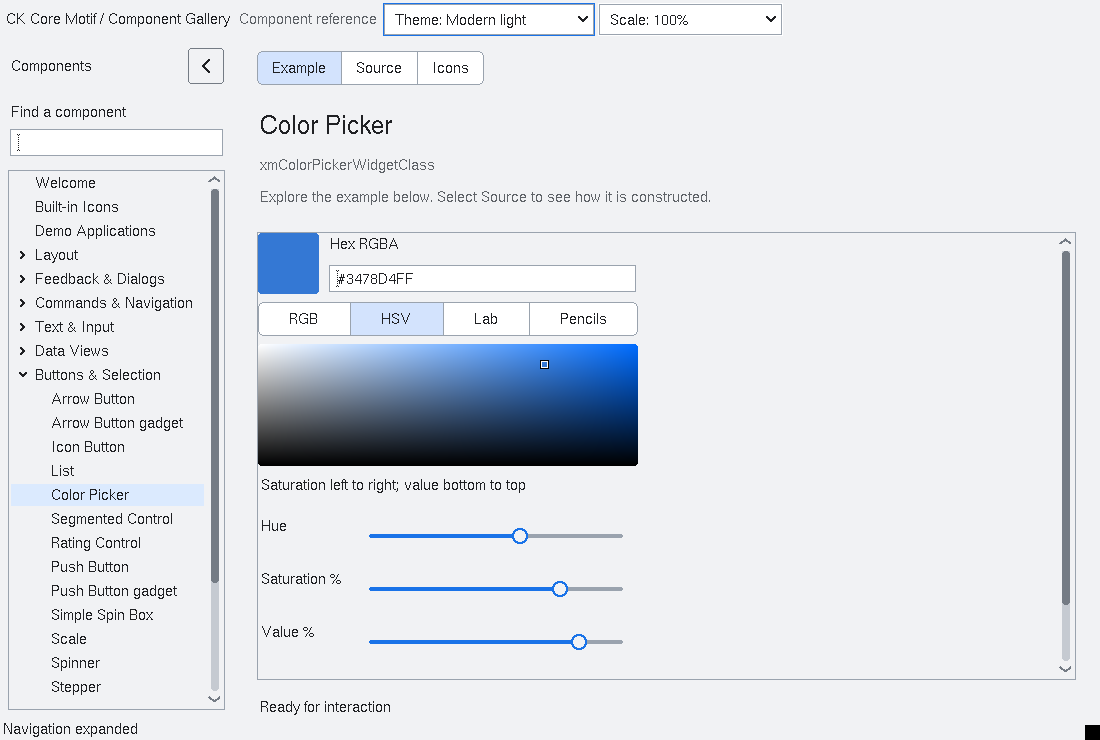
XmColorPicker provides four mutually exclusive, tab-like modes using the native
SegmentedControl. HSV is the default. The library owns all styling and measured
geometry; the gallery only creates the control and sets its initial color.
| Mode | Visual selection | Numeric controls |
|---|---|---|
| RGB | Shared color/alpha preview | Red, green, blue, alpha (0–255) and hex |
| HSV | Saturation/value field; hue sets the field's color | Hue (degrees), saturation/value (%) and alpha |
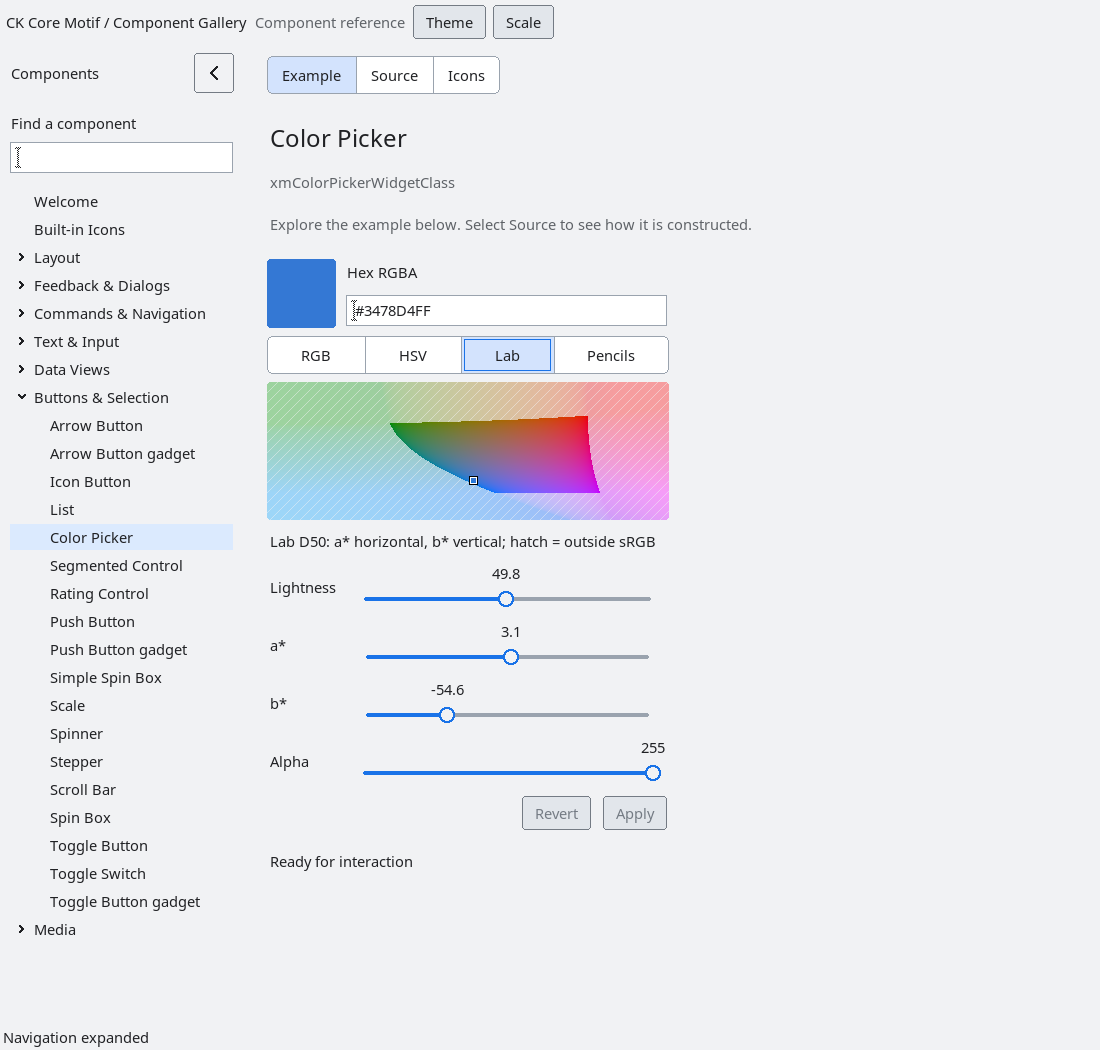
| Lab | a/b field at the selected lightness | CIE Lab D50 lightness, a, b and alpha |
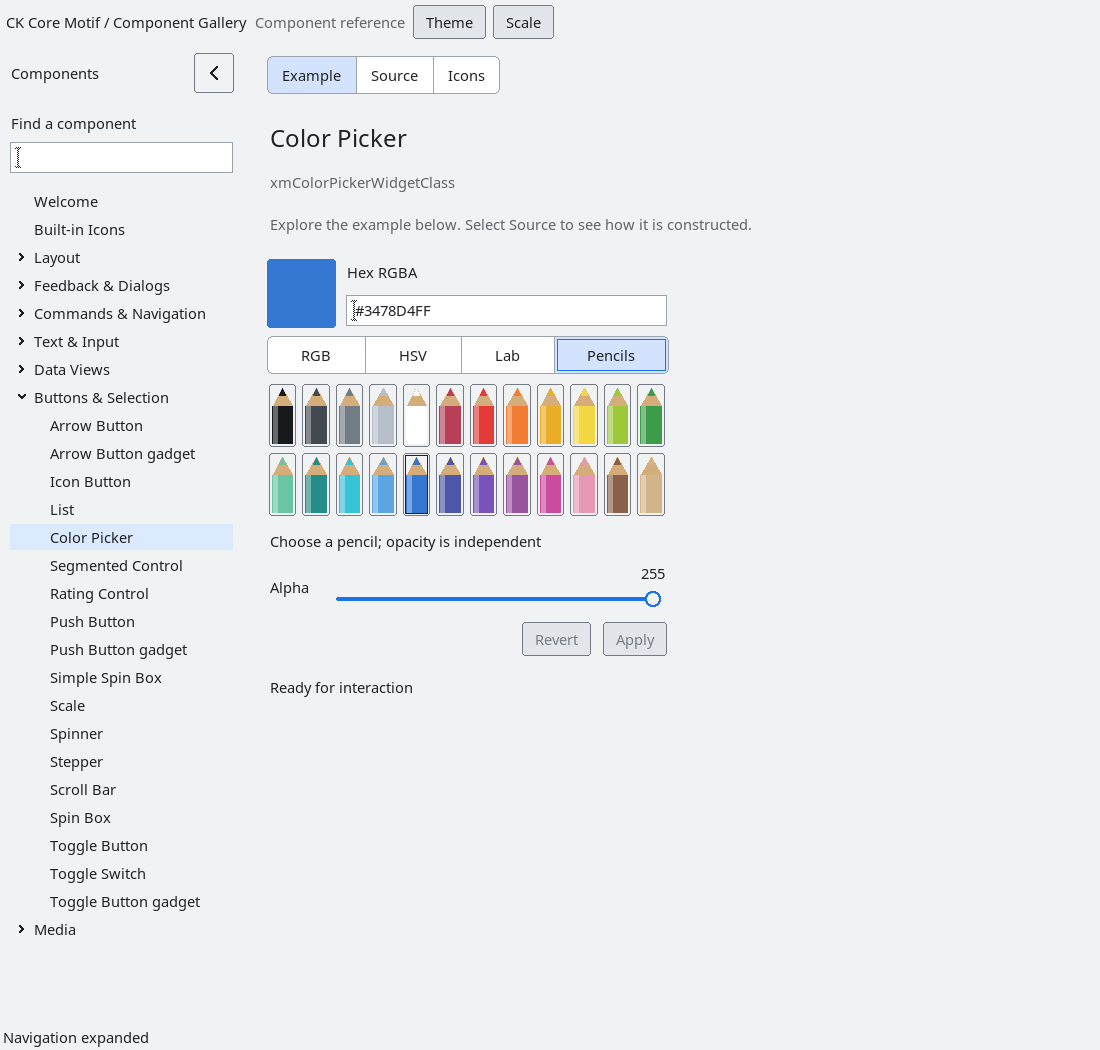
| Pencils | 24 colored pencils, each a named native button | Shared alpha and hex |
The swatch, hex editor, Apply and Revert remain available in every mode. Switching modes does not convert, commit or change the current color; it preserves pending hex text. A common measured width prevents the editor and mode strip shifting horizontally. Natural height follows the selected content. Constrained hosts may scroll the composite. Explicit width/height independently own their axes; setting an axis to zero restores its natural size. Layout and pencil ordering mirror for right-to-left applications, while color-field axes retain their documented meaning.
Visual selection modes
The following gallery captures show the library-owned modern light appearance. Use the mode strip inside the component to change the editing model.
Color and gamut contract
Committed and preview values are 32-bit sRGB 0xRRGGBBAA, with eight bits per
channel. The unsigned-long API normalizes values to the low 32 bits. Hex accepts
six or eight digits, optionally prefixed by #; six digits imply opaque alpha.
Canonical text is #RRGGBBAA.
HSV operates on encoded sRGB. Achromatic edits preserve the chosen hue; editing black also retains the chosen saturation until another color source replaces it. Lab uses the D50 white point, sRGB transfer functions, and Bradford chromatic adaptation between D65 and D50. The conversion follows the CSS Color 4 color-conversion model. This is an sRGB picker, not an ICC-managed monitor or wide-gamut editor.
Muted hatching marks Lab coordinates outside sRGB. Selecting those coordinates retains the requested Lab cursor and slider values, clips the resulting RGB channels to the output range, and shows an explicit gamut notice. The swatch and hex editor show that actual clipped output. Applying commits the displayed sRGB value. Alpha is independent of every color mode and composites over a checkerboard.
Editing and API
Valid text, slider, color-field and pencil edits update the preview. A changed
packed value emits XmNcolorPickerPreviewCallback; selecting a different mode
alone does not. Apply or Return commits and emits
XmNcolorPickerValueChangedCallback only when the committed color changes.
Invalid text leaves both values intact; attempting to commit shows validation.
Revert or Escape restores the committed preview and text. Native buttons support
release-outside cancellation. The field supports mouse dragging, arrow keys,
Shift+arrow for larger steps, Home/End for horizontal endpoints, and Return.
XmColorPickerGetValue/XmColorPickerGetPreviewValue: committed/preview RGBA.XmColorPickerSetValue: replace both values, optionally notify commit.XmColorPickerPreviewValue: replace preview only.XmColorPickerSetMode/XmColorPickerGetMode:XmCOLOR_PICKER_RGB,XmCOLOR_PICKER_HSV,XmCOLOR_PICKER_LABorXmCOLOR_PICKER_PENCILS.XmColorPickerPreviewHSV: hue 0–360, saturation/value 0–1; preserves alpha.XmColorPickerPreviewLab: L* 0–100 and a/b −128–127; preserves alpha.XmColorPickerCommit(widget, notify): False for invalid text.XmColorPickerRevert: restore committed color.XmColorPickerGetTextField: borrowed editor owned by the picker.
Invalid/non-finite model arguments are rejected without changing the preview. Callbacks may destroy the picker. Native fonts and foregrounds inherit application settings while retaining explicit child overrides. The color field caches its raster by model parameter, allocation, sensitivity, background and colormap. TrueColor uses visual masks; indexed displays use a bounded, owned palette with nearest existing-color fallback. Cached pixmaps and allocated colors are released.
The field skips a transient zero-sized allocation and abandons a failed server
pixmap allocation before issuing any drawing request. Its shared swatch GC is
created only after its one-pixel setup drawable exists; plane and pencil redraws
skip safely if that GC is unavailable. The next valid expose retries the cache
creation; no stale or invalid drawable is retained.
tests/automated/check-colorpicker-plane-allocation.py keeps that drawable
allocation contract explicit.
Accessibility and validation
The parent exposes a color-chooser role with packed committed value, hex text and Apply/Revert actions. Visible RGBA and model channels expose named sliders with their actual bounds and units. Pencil buttons expose their color names and native activation; the two-dimensional field also has a descriptive focusable identity. Numeric sliders provide an alternative to every visual field edit. Semantic writes respect sensitivity, visibility and modal admission.
run-colorpicker-native.py checks editing, alpha pixels, geometry, live metrics,
semantic actions and callback destruction. run-colorpicker-modes.py checks the
four modes, native pointer/keyboard input, RTL, tiny allocations, gamut handling,
alpha preservation and accessibility. It also checks 4,096 sRGB/HSV/Lab round trips
and known D50 reference values. Run both in Xft/SVG and core-font/non-SVG builds.
The pending epoch-9 private layout changes require consumer/subclass rebuilds.
The separate legacy XmColorSelector remains available.
Component demo
Captured gallery example and its corresponding source excerpt.
Actual gallery excerpt: class = xmColorPickerWidgetClass. The host supplies parent, name, callback and client_data. Shared factory locals: Widget example; XmString label = NULL. The shared factory frees label, attaches callbacks and sizes the preview. Helpers and the complete factory are in gallery_examples.c.
example = XtVaCreateManagedWidget((char *)name, class, parent, NULL);
XmColorPickerSetValue(example, 0x3478d4ffUL, False);
color-read-storage.md
ColorObj read-side storage validation
_XmGetColor now requires the per-screen color-use and color-set arrays to
exist before reading them. A partially initialized ColorObj therefore returns
failure instead of indexing missing storage; valid running ColorObj reads are
unchanged.
tests/automated/check-color-read-storage.py protects this contract.
color-selection-inputs.md
ColorObj selection callback input validation
GetSelection now rejects missing callback widgets, selection atoms, atom
storage, or screen metadata before scanning or writing state. It also avoids
dereferencing a missing transfer length when no property value is supplied.
tests/automated/check-color-selection-inputs.py protects this contract.
color-selector-channel-bounds.md
ColorSelector channel bounds
XmColorSelector keeps RGB slider state in int fields but exposes it as
8-bit RGB text and 16-bit X11 color channels. Incoming slider callback values
are now normalized to 0–255, and the same normalization is applied before
formatting a hex name or constructing XColor. This keeps malformed or custom
scale callbacks from producing an invalid color string or wrapping a channel.
Filename-change detection also now converts strcmp to an explicit Boolean,
so every non-equal string is reliably treated as changed.
The focused source contract is covered by
tests/automated/check-color-selector-channel-bounds.py.
color-selector-format-bounds.md
ColorSelector RGB formatting bounds
ColorSelector derives hexadecimal RGB names into its fixed color-name buffer. The value is normally short, but its writes should still honor the buffer contract.
Both slider and parsed-color paths now use snprintf with the destination
size. The generated #rrggbb names and label behavior are unchanged.
tests/automated/check-colors-selector-format-bounds.py protects both paths.
color-selector-layout-geometry.md
ColorSelector layout geometry
XmColorSelector derives child widths and heights by subtracting margins,
radio-box geometry, and borders from the selector's current size. Those
members are X toolkit unsigned dimensions, so doing the subtraction directly
could wrap a tiny selector into a nearly 64K-wide child. The layout now uses
signed intermediates, clamps negative available space to zero, and avoids
subtracting borders from a color area that is too small to contain them. The
radio-box centering calculation also performs its subtraction in signed
arithmetic.
This preserves the normal layout for usable sizes while making very small or temporarily collapsed selectors deterministic during resize and realization.
The final widths, heights, and accumulated positions are also converted through
explicit range guards. This prevents a large margin or stacked child geometry
from narrowing into a wrapped Dimension or signed Position, which could
place children on the opposite edge of the selector.
color-selector-name-scope.md
Color selector replacement-name scope
XmColorSelector can replace a hexadecimal color name with the matching
named color after parsing the slider value. The replacement pointer now has
function scope, so both selector update paths compile while preserving the
existing allocation, failure, and ownership behavior.
color-selector-preferred-size.md
ColorSelector preferred size
XmColorSelector derives its preferred size by combining all internal child
geometries, borders, and margins. The accumulation now uses a wide type and
saturates at the Dimension maximum. A large child or many children can no
longer wrap the preferred size into a smaller value that destabilizes geometry
negotiation.
The focused source contract is covered by
tests/automated/check-color-selector-preferred-size.py.
colorobj-init-cleanup.md
ColorObj initialization cleanup
ColorObj initialization publishes the per-display object before allocating its per-screen arrays. If one of those allocations fails, the object is now removed from both the X context and the global ColorObj chain before the initializer returns. This prevents later lookups from reusing an unusable partially initialized object.
colorobj-name-table-allocation.md
ColorObj screen-name table allocation
Color initialization builds a temporary table of screen-name pointers through
XmStackAlloc. That macro narrows heap allocations to an unsigned size, so
the table check now bounds both size_t and UINT_MAX before multiplication.
Normal screen-name construction is unchanged; an unrepresentable table falls
back to the existing failure path.
colorobj-pixel-data-rollback.md
Color-object pixel-data rollback
FetchPixelData parses a server-provided pixel-set property before updating
the display color object. Malformed input must not leave the selector
(colorUse) changed while the associated pixel fields are still old or
partially parsed. The parser now publishes colorUse only after every color
field has validated and UpdateXrm has completed.
The focused source-contract check is:
python3 tests/automated/check-colorobj-pixel-data-rollback.py
colorobj-property-trailing-data.md
Color-object property trailing data
The ColorObj server property has a fixed sequence of underscore-terminated
hexadecimal fields. After parsing the selector and every pixel-set field,
FetchPixelData now requires the cursor to be at the terminating NUL. Trailing
bytes are rejected before any color state is published.
The focused source-contract check is:
python3 tests/automated/check-colorobj-property-trailing-data.py
colorobj-type-boundaries.md
Color object type boundaries
XmColorObj obtains its screen count from Xlib as a signed int, while Xt's
allocation API accepts a Cardinal. Initialization allocates its per-screen
arrays only for a positive count and makes that signed-to-unsigned conversion
explicit at the allocation boundary. An anomalous non-positive count follows
the established allocation-failure path rather than becoming a very large
allocation request.
The selection-timeout sentinel is represented as (unsigned long)-1, matching
the type returned by Xt. It is compared using the same unsigned type before a
saved timeout is restored.
ColorCachePropertyExists keeps Xlib's integer request status separate from
its Boolean parse result. X errors are checked against Success; the caller
receives only True when the bounded pixel-set payload was parsed successfully.
colorpicker-highlight-geometry.md
ColorPicker focus and geometry
ColorPicker now delegates text, focus and buttons to native controls. Its only
custom painting is the passive alpha-aware swatch, clipped to its allocated
bounds. The obsolete Primitive focus rectangle and text GC have been removed.
Native geometry and rendering are checked by run-colorpicker-native.py; see
ColorPicker for the current interaction contract.
column-label-name-bounds.md
Column label names
Column creates an internal label child by appending _label to each child
widget name. The legacy path truncated names longer than 240 bytes before
adding the suffix, which could make distinct long names collide.
The generated name is now measured and allocated to its full length, then
released after widget creation. Existing short names and the _label naming
contract are unchanged.
tests/automated/check-column-label-name-bounds.py protects this behavior.
combobox-delete-selection-pointer.md
ComboBox deletion selected-position pointer
XmComboBoxDeletePos reads the child List’s selected position before
repairing selection after a deletion. A positive selected-position count does
not guarantee that the returned array pointer is available. The repair path
now treats a missing array as no selected position, avoiding a null
dereference while preserving the existing behavior for valid List results.
The regression contract is checked by
tests/automated/check-combobox-delete-selection-pointer.py.
combobox-get-selected-pointer.md
ComboBox selected-position export
The synthetic XmNselectedPosition export obtains both a count and an array
from the child List. A positive count does not make the array pointer safe to
dereference if the query cannot provide it. The export now returns the
documented no-selection value (0) unless both the count and pointer are
valid; ordinary selected positions and zero-based conversion are unchanged.
The export also returns safely when Xt supplies no widget or output pointer.
The regression contract is checked by
tests/automated/check-combobox-get-selected-pointer.py.
combobox-selected-import-input.md
ComboBox selected-position import input
The synthetic selected-position import procedure receives an XtArgVal
pointer from resource conversion. A malformed or private caller can provide
no widget or no value pointer; dereferencing either before the child-creation
check would crash the process. The import now returns the existing
XmSYNTHETIC_NONE result for null inputs and keeps valid resource conversion
unchanged.
Zero-based imports also reject XmINVALID_POSITION and other negative values
before applying the compatibility +1 conversion, preventing -1 from
becoming List position zero (which means the last item).
The regression contract is checked by
tests/automated/check-combobox-selected-import-input.py.
combobox-selection-pointer.md
ComboBox selected-position pointer
The ComboBox list action obtains both a selected-position count and the
selected-position array through XtGetValues. A nonzero count is not enough
to make the pointer safe to dereference if the list cannot provide its array.
Navigation now requires both a positive count and a non-null position pointer;
otherwise it leaves the current selection unchanged and avoids a null
dereference.
The regression contract is checked by
tests/automated/check-combobox-selection-pointer.py.
combobox-selection-sync.md
ComboBox selection-to-text synchronization
When a child List selection changes, ComboBox mirrors the selected item into its edit field. The old path assumed that positive counts implied non-null arrays and that the first position was within the item count. Synchronization now requires both arrays and a one-based position in range before indexing the item table; malformed or failed List queries leave the edit field unchanged.
The regression contract is checked by
tests/automated/check-combobox-selection-sync.py.
combobox-up-boundary.md
ComboBox Up-navigation boundary
ComboBox list positions are one-based. The Up action previously accepted the
first position (1) and subtracted one before calling XmListSelectPos,
passing the invalid position 0. Up now moves only when the selected
position is greater than one; at the first item it remains selected, matching
normal keyboard navigation and preserving the public one-based List contract.
The regression contract is checked by
tests/automated/check-combobox-up-boundary.py.
command-api-inputs.md
Command convenience API inputs
The public Command helpers now reject non-Command widget handles before
obtaining an application context or reading Command-private children. This
covers XmCommandGetChild, XmCommandSetValue, XmCommandAppendValue, and
XmCommandError; null and optional-value behavior remains unchanged.
The focused source regression is
tests/automated/check-command-api-inputs.py.
command-palette-allocation-bounds.md
CommandPalette item-array bounds
XmCommandPaletteSetItems now validates the requested item count before
allocating stored command records. The multiplication must fit both native
size_t arithmetic and Xt's Cardinal allocation width; oversized requests
return with a warning before any item records are accessed.
The focused source-contract check is:
python3 tests/automated/check-command-palette-allocation-bounds.py
command-palette-geometry-bounds.md
Command Palette geometry bounds
XmCommandPalette now saturates its preferred height before writing an X11 Dimension. Its list child also uses a representable signed Position, and the remaining list height is clipped to the X11 signed-coordinate range.
Ordinary palette layouts are unchanged. At pathological geometry sizes, the control retains a visible one-pixel list extent instead of wrapping a preferred height or passing a negative child y-coordinate to Xt.
The focused source-contract check is:
python3 tests/automated/check-command-palette-geometry-bounds.py
command-palette-rebuild.md
CommandPalette rebuild allocation
CommandPalette filtering now allocates only the text needed to evaluate the
filter and the final compound string inserted into the list. A previously
constructed plain C string was never displayed; its allocation could therefore
make a valid command disappear on transient memory pressure. Shortcut labels
continue to be rendered through the existing XmString path.
command-palette-selection-pointer.md
CommandPalette selected-position result
CommandPalette invocation maps the selected List position into its filtered
visible-item array. A positive selection count does not guarantee that the
position array is available after an allocation failure. Invocation now
rejects a null array before reading positions[0]; valid selections and
callback delivery remain unchanged.
The regression contract is checked by
tests/automated/check-command-palette-selection-pointer.py.
compact-controls-contract.md
WP-35 compact content and adornment contract
WP-35 is split into independently releasable controls. Each control owns
only its content and callbacks; placement remains the application's job. No
control changes the resources or geometry of an existing XmLabel,
XmSeparator, button, list, or pixmap.
Chip / Tag / Token
The first implementation target is XmChip, a bounded label with optional
leading pixmap and an optional remove action. The public model is one copied
XmString label, one optional pixmap, a Boolean enabled state, and a Boolean
removable state. The remove callback reports the widget and input event but
does not destroy the widget implicitly. Applications own the surrounding
collection and call a setter or destroy the chip after the callback.
Chip activation is keyboard-accessible when removable: Space/Return invokes the normal activation callback and Delete/Backspace invokes removal. Removal has a visible non-colour affordance and remains available in high contrast. There is no implicit list model, drag behavior, truncation menu, or global overlay. Tag and Token remain aliases/configurations of this same bounded contract unless a consumer demonstrates a distinct semantic requirement.
Badge
XmBadge is a non-interactive status presentation with either a copied text
label or a bounded non-negative count. Counts above the configured maximum
render as maximum+ and remain available as an accessible value. Severity
is an enum with informational, success, warning, and error values; severity
never relies on colour alone. Badges do not attach themselves to a host
widget and never resize or overlay one implicitly.
The additive implementation is documented in docs/badge.md; its installed
fixture covers count clamping, label ownership, severity resources and the
read-only accessibility value.
Icon-and-text label and Divider
An icon-and-text label is an additive configuration of a label-like control: the icon and text are copied/owned by the control and its direction-aware layout is measured as one row. A text Divider is non-interactive, exposes a copied optional label, and has an explicit orientation and thickness. Neither control introduces a new text value or callback contract.
Avatar
XmAvatar accepts an optional pixmap and a copied fallback initials string.
When the pixmap is unavailable or invalid, initials are rendered; fallback is
deterministic and does not load files or URLs. The control is non-interactive
unless an application composes it with a separate button. It does not create
a global image cache or modify host geometry.
The additive implementation is documented in docs/avatar.md; its installed
fixture covers explicit sizing, unspecified-pixmap fallback, initials
ownership and the read-only accessibility label.
Work packages and acceptance
- Implement and test
XmChipwith label/pixmap ownership, remove and activation callbacks, keyboard operation, sensitivity, narrow geometry, high-contrast rendering, accessibility, and destruction from callbacks. - Implement and test
XmBadgewith bounded counts, severity states, localization, non-colour semantics, and no implicit host placement. - Implement the icon-label and Divider configurations, preserving ordinary label/separator behavior and measuring RTL/narrow layouts.
- Implement
XmAvatarwith pixmap failure and initials fallback tests. - Run the unchanged legacy Label, Separator, pixmap and ToggleButton fixtures plus every new installed-prefix fixture before releasing the package.
The package is complete only when every accepted control has a documented public contract, an installed consumer fixture, and teardown/reentrancy coverage. Any control without a consumer-ready contract remains deferred.
compound-segment-bounds.md
Compound-string segment size bounds
When a compound-string segment is returned with indentation or a separator,
the converter allocates a new buffer and prepends tabs or appends a newline.
The old code stored the resulting length in an int, even though the source
length is size_t. A large segment could therefore wrap the length and cause
an undersized allocation before the copy.
The conversion now keeps the length in size_t and rejects an unrepresentable
prefix-plus-segment size as an invalid segment before allocating. Ordinary
compound strings retain the same bytes and separator behavior. The source
regression in tests/automated/check-compound-segment-bounds.py protects the
checked arithmetic and the non-overflowing type.
compound-text-converter-display.md
Compound-text converter display input
The public compound-text converter wrappers now reject a null Display *
before attempting conversion diagnostics. A failed conversion previously
passed that pointer to XtDisplayToApplicationContext, which could crash for
direct malformed calls. Valid Xt converter calls retain their normal warnings
and conversion behavior.
Regression coverage: tests/automated/check-compound-text-converter-display.py.
compound-text-converter-inputs.md
Compound-text converter inputs
XmCvtTextToXmString now returns False when its Xt converter input or output
record is absent. The previous implementation dereferenced those records
before checking the contained text pointer. Valid converter calls retain their
existing conversion and warning behavior.
Regression coverage: tests/automated/check-compound-text-converter-inputs.py.
container-cell-info-allocation.md
Container cell-layout allocation
XmContainer uses temporary per-child metadata while calculating an ideal
size for XmCELLS layouts. The allocation is now checked for size overflow
and failure before the child list is traversed. If the metadata cannot be
created, sizing returns safely instead of dereferencing a null array; normal
layouts and their compatibility behavior are unchanged.
tests/automated/check-container-cell-info-allocation.py protects this
contract.
container-cell-reset-cleanup.md
Container cell-grid reset cleanup
XmContainer subclasses may omit the optional remove_item class hook. A
spatial reset still owns its prior occupancy grid in that case. Reset now
invokes the hook only when supplied, then always releases and clears the old
grid before rebuilding or returning for a non-spatial layout. This prevents a
leak and stale grid state without changing hook behavior for existing classes.
container-cells-allocation.md
Container CELLS allocation bounds
The CELLS ideal-size path now checks both size_t and Xt Cardinal product
limits before allocating one geometry record per child. An unrepresentable
array is rejected before XtCalloc, avoiding truncation in the allocator.
The focused source contract is checked by
tests/automated/check-container-cells-allocation.py.
container-child-count-bounds.md
Container child-list count bounds
XmContainerGetItemChildren now checks the public int count before each
linked-list increment. An unrepresentably large or corrupted child list is
rejected instead of wrapping the count and allocating an undersized result
array.
The focused source contract is checked by
tests/automated/check-container-child-count-bounds.py.
container-clipboard-inputs.md
Container clipboard command input contract
XmContainerCut, XmContainerCopy, and XmContainerCopyLink now return
False for a null widget before container casting, application-context setup,
or clipboard dispatch. Valid container clipboard behavior is unchanged.
container-compare-int.md
Container integer comparison
Container reorder sorting now compares position indices relationally instead of subtracting them. This preserves the same ordering while avoiding signed integer overflow when malformed or extreme indices reach the comparator.
container-destination-prehook-guard.md
Container destination prehook validation
ContainerDestPrehookProc now rejects callbacks without a transfer handle
before allocating location data or invoking transfer completion APIs. This
keeps malformed or stale destination callbacks from reaching the transfer
machinery with a null identifier.
container-disclosure-sensitivity.md
Container disclosure sensitivity
Container disclosure buttons are synthetic siblings of the real outline row.
OutlineButtonAction now checks the row handle and its effective sensitivity
before reading constraints, changing outline_state, or delivering the
outline callback. A disabled row therefore cannot be expanded or collapsed by
an activated proxy gadget or a keyboard action.
The guard is deliberately before parent/constraint access and leaves enabled
rows and all callback ordering unchanged. The focused source regression is
tests/automated/check-container-disclosure-sensitivity.py.
container-disclosure-state.md
Container disclosure state
Container outline mode creates a small synthetic push-button gadget beside
each expandable row. The gadget's constraint record stores the link back to
the row; the row's constraint record owns outline_state.
ChangeOutlineButtons now follows that link before selecting the expanded or
collapsed pixmap. Refreshes therefore preserve the visible disclosure state
instead of silently repainting every button as collapsed. The refresh path
also skips detached or incomplete synthetic gadgets safely.
tests/automated/check-container-disclosure-state.py protects the association
lookup and both constraint guards.
container-header-position-bounds.md
Container header position bounds
When a Container changes between outline and detail modes, header height is
now applied through the existing saturating signed-position helper. This
prevents large header dimensions from wrapping core.y during subtraction or
assignment.
The focused source contract is checked by
tests/automated/check-container-header-position-bounds.py.
container-move-destination-guard.md
Container drag destination validation
The internal drag-move callback now stops when the transfer has no destination callback record. Transfer lookup can fail for a stale or malformed transfer; continuing in that case would dereference missing state after moving an item.
Valid drag-and-drop transfers continue through the existing placement path.
container-relayout-inputs.md
Container relayout input contract
XmContainerRelayout now returns immediately for a null widget before
application-context lookup, realization checks, or container casting. Valid
container relayout behavior is unchanged.
container-reorder-inputs.md
Container reorder input contract
XmContainerReorder now returns before context lookup when its widget or child
list is absent, when fewer than two children are supplied, or when any listed
child is null. Valid reorder operations are unchanged, while malformed caller
input no longer reaches constraint lookup or sorting.
container-tab-pool-bounds.md
Container dynamic tab-pool bounds
Dynamic detail tabs are built from a per-call temporary pool. Its checked
size_t byte count is now converted explicitly to Xt's Cardinal allocator
size after the existing overflow guards, keeping the allocation contract
visible on both 32-bit and 64-bit builds.
The focused source contract is checked by
tests/automated/check-container-tab-pool-allocation.py.
container-transfer-allocation.md
Container transfer allocation
Container primary-transfer actions keep a temporary event context, and copy/link/move and drop callbacks keep temporary pointer coordinates. All of these allocations are now checked. An allocation failure abandons only the current transfer setup or callback, leaving the widget and existing transfer state valid instead of dereferencing a null pointer.
tests/automated/check-container-transfer-allocation.py protects this
contract.
context-menu-decision.md
Context-menu entry decision
Scope
WP-39 asks whether Motif needs a new context-menu entry abstraction for icon-and-shortcut actions. This package covers entry presentation and dispatch only; it does not change drag-and-drop ownership, menu admission or application command routing.
Evidence
The existing public contract already provides the required pieces:
XmCreatePopupMenucreates a normal popup menu using the existingXmRowColumnmenu behavior;XmPushButtonentries acceptXmNlabelPixmapfor an icon andXmNlabelStringfor the visible label;XmNacceleratorinstalls the keyboard binding andXmNacceleratorTextdisplays its human-readable form; andXmNactivateCallbackdispatches the selected entry to application-owned code.
The installed consumer fixture check-context-menu-contract.c creates these
public widgets, verifies the label, icon, accelerator and displayed shortcut,
and invokes the callback. It passes 9 checks repeatedly on the qualified
AArch64 uconsole prefix under Xvfb.
Decision
No new context-menu widget or parallel entry API is justified. A new wrapper
would duplicate existing RowColumn/PushButton semantics, create another
shortcut ownership contract and risk diverging from Motif menu behavior.
Applications that need a higher-level command model can continue to use the
documented XmCommandPalette or XmToolbar contracts while constructing
ordinary context menus from the public Motif menu and button APIs.
This is a completed no-go decision for the WP-39 context-menu sub-item. It does not restrict future additive APIs if an installed consumer demonstrates a requirement that the existing menu contract cannot express.
convert-drop-context.md
Motif-drop conversion context
The shared conversion handler hides the real selection atom for drag and drop
and obtains it from the active drag context. It now rejects a Motif-drop
external conversion when that context has already been cleared, returning an empty
failure result before any XtGetValues or selection-request lookup. This
keeps cancelled or failed drags from dereferencing a null context.
The regression check is tests/automated/check-convert-drop-context.py.
Local export-target negotiation is an intentional exception: XmeDragSource must query targets before XmDragStart creates the context. The one-shot local flag is consumed before early failures. The native DNDDemo regression checks this exception, retained rejection of external requests, and real drags.
copied-label-destructors.md
Copied-label destructors
Avatar initials, Divider labels, and IconLabel labels are copied into widget
state during initialization and replacement. Their destructors now release
those owned XmString copies, matching the ownership behavior of the other
custom label widgets.
cpp-support-library-proposal.md
Optional C++ support-library proposal (WP-08)
This is a design boundary, not a replacement object model and not a required
libXm dependency. Existing C callers and the Xt/Motif ABI remain authoritative.
The proposal addresses the most repetitive C++ consumer work while keeping raw
widgets and resource names visible at the boundary.
Proposed small surface
namespace motif {
class string;                 // owned XmString; copy duplicates, move transfers
class args;                   // ordered XtArgVal storage; names remain Xm resource names
class widget_ref;             // non-owning Widget view; never destroys the widget
class callback_connection;    // RAII XtAddCallback/XtRemoveCallback registration
}
motif::string owns exactly one XmString and frees it with XmStringFree.
It has explicit UTF-8/localized construction, copy and move operations; no
implicit conversion to a mutable char * is provided. motif::args owns its
argument storage until the Xt call returns and forbids mutation after passing
the array to Xt. widget_ref is intentionally non-owning and can be empty.
callback_connection stores the callback identity and borrowed closure exactly
as Xt does. Destruction unregisters on the owning display thread. A callback
trampoline catches every C++ exception, records it in an application-owned
error sink and returns across the C ABI; exceptions never cross Xt. The
connection does not keep an arbitrary Widget alive, and widget destruction
invalidates a connection before its owner releases the wrapper.
Interoperation and ownership rules
- Raw
Widgetvalues can be constructed intowidget_refand extracted for existing C calls; no private Xm records or global wrapper registry are used. - Wrappers are movable, but only
stringowns toolkit memory. Copying awidget_reforargsview does not create widget ownership. - All widget, display, Xt callback and wrapper destruction operations run on the owning Xt application thread.
- The support layer is an exception barrier and value-ownership aid, not a thread-safe widget facade or an asynchronous dispatch mechanism.
- The released support layer remains header-only at the implementation level, but is installed as a versioned public header with pkg-config metadata after the installed-prefix lifecycle test proves the callback/destruction contract.
Consumer examples to validate
- Build a localized
motif::string, pass it to a normal Label resource and verify copy/move/destruction with an installed prefix. - Build ordered
motif::argsfor a C-created widget, then reuse the same raw widget throughwidget_refwithout private-record access. - Register a callback with a borrowed closure, destroy the widget first and
release the
callback_connectionafterward; verify no callback or use-after- free occurs. - Throw from a callback and verify the exception sink receives it while Xt continues unwinding normally.
Decision
WP-08 design is complete and WP-09 is GO: the lifecycle and exception-barrier fixture passes against a fresh installed prefix with GCC, Clang and sanitizer variants, so the optional header and pkg-config package are released without changing the stable C ABI. The native AArch64 evidence does not close the toolkit-wide x86_64 qualification gate.
cpp-support-library-prototype.md
C++ support-library prototype (WP-08)
This document records the consumer-side fixture that drove the optional C++
support layer. The public header is now installed as
ckmotif++/motif_support.hpp; this fixture remains the lifecycle proof against
a real installed prefix and does not change libXm, Xt resources, UIL,
callbacks or widget ownership.
Supported prototype contract
motif::stringowns oneXmString; copies duplicate the toolkit value and moves transfer it. Destruction callsXmStringFreeexactly once.motif::argsowns copied resource names andXtArgValvalues.apply()builds a temporary nativeArgarray for one Xt call and seals the list so its storage cannot be mutated after hand-off.motif::widget_refis a non-owning view. It never destroys or registers a global wrapper for theWidget.motif::callback_connectionowns one Xt callback registration and a destroy callback that invalidates the connection when the widget is destroyed first. Its C callback trampoline catches the callback and error sink exceptions before returning through Xt.
All operations remain on the owning Xt application thread. The support layer does not provide asynchronous dispatch, thread safety, private-record access or an implicit event loop. See the installed support-library reference for the release contract and package metadata.
Installed-prefix check
Run it against a fresh ABI-matching install:
python3 tests/automated/run-cpp-support-prototype.py \
  --prefix /absolute/installed/prefix \
  --out /absolute/fresh/cpp-support-results
The runner records source/header hashes, compiler/linker commands, loaded
libXm.so.8 identity and the Xvfb result in receipt.json. The fixture
covers copied/moved XmString values, one-shot argument storage, raw-widget
interoperation, move-only connection ownership, callback exception capture,
callback continuation after the exception, and destruction-before-connection-
release. Pass --sanitize for AddressSanitizer/UBSan with leak detection.
cpp-support-library-release-decision.md
WP-09 optional C++ support-library release decision
WP-08's consumer-side header and lifecycle fixture now qualify the installed
ckmotif++ package. Its motif::string, motif::args, motif::widget_ref
and motif::callback_connection types pass a fresh AArch64 installed prefix
with GCC and Clang, including callback exception barriers,
widget-destruction ordering, mixed C/C++ ownership and sanitizer runs with
leak detection enabled.
Decision
Go for WP-09 release. Install the header-only, separately versioned
ckmotif++-9 package and its pkg-config metadata. Keep libXm's C ABI
unchanged; do not hide a global widget registry or claim thread-safe widgets.
The accepted release evidence is a fresh installed prefix and proves, at minimum:
- copied and moved
XmStringownership with no leaks or double frees; - ordered argument storage whose lifetime ends at the Xt call boundary;
- callback unregister/destruction ordering when the widget is destroyed first;
- an exception barrier that catches every exception before returning through the C callback ABI; and
- mixed C-created/C++-wrapped widget use without private-record access.
The package remains optional, separately versioned and independent of a clean C
libXm build. The native AArch64 result does not close the toolkit-wide
x86_64 qualification gate.
Installation contract
Configure with --enable-cxx-support to install the header and
ckmotif++-9.pc. The default C build does not install or compile this optional
package, and libXm retains its unchanged C ABI. The installed-prefix
consumer fixture remains the release gate for callback, ownership and
destruction behavior.
The clean qualification build also covers the core C library: the scroll-frame navigator capacity guard includes the standard integer-limit definitions it uses, so the optional package does not depend on an incidental transitive include from a particular compiler or system header set.
cpp-support-library.md
Optional C++17 support library
CK Core Motif can install an optional, header-only C++17 support layer as
ckmotif++. It is an ownership and exception-boundary aid for the existing
Xt/Motif ABI, not a second widget toolkit.
Installation and use
The support layer is opt-in at build/install time through the normal headers and pkg-config metadata. A consumer can use:
c++ -std=c++17 widget.cpp $(pkg-config --cflags --libs ckmotif++-9)
The installed header is ckmotif++/motif_support.hpp; the package metadata is
ckmotif++-9.pc. The C++ layer adds no required dependency to a C-only
libXm build and leaves the Motif ABI unchanged.
Contract
motif::stringowns oneXmString; copies duplicate it and moves transfer ownership. Destruction callsXmStringFreeonce.motif::argscopies resource names and storesXtArgValvalues in order.apply()constructs a temporary nativeArgarray, seals the list only after construction succeeds, and requires the callback not to retain that array after it returns.motif::widget_refis a non-owning view. It never destroys or registers a global wrapper for aWidget.motif::callback_connectionowns one Xt callback registration and installs a destroy callback. Widget-first destruction invalidates the connection; reset from inside a callback defers state deletion until the active trampoline returns.- The callback trampoline catches both the user callback and error-sink exceptions before returning through Xt's C ABI.
All widget, display, callback-registration and wrapper-destruction operations must run on the owning Xt application thread. The layer does not provide thread-safe widgets, asynchronous dispatch, private-record access or an implicit event loop.
Qualification
tests/automated/run-cpp-support-prototype.py compiles the installed header,
checks that the executable resolves libXm.so.8 from the selected prefix and
runs the lifecycle fixture under Xvfb. The accepted release matrix covers a
fresh installed prefix with GCC and Clang, plus AddressSanitizer/Undefined
BehaviorSanitizer runs with leak detection enabled. The fixture exercises
copy/move ownership, ordered argument storage, mixed C/C++ widget use,
callback exception capture, callback continuation, widget-first destruction
and explicit connection reset.
The matrix is native AArch64 Linux on uconsole; x86_64 remains a separate
toolkit-wide qualification gate. No claim is made that the wrappers make
Xt thread-safe or that a system Xt leak outside this support layer is owned by
the C++ package.
cutpaste-atom-name-guards.md
CutPaste atom-name guards
Clipboard conversion now handles failed XGetAtomName calls in both target
format lookup and returned-type inspection. A failed target lookup reports a
conversion failure; a failed returned-type lookup preserves the atom as the
type without indexing a null string. Successful clipboard behavior is
unchanged.
cutpaste-callback-table-bounds.md
Clipboard callback-table growth bounds
When a clipboard callback table is full, Motif grows both callback tables by
20 entries. The growth path now rejects integer overflow and checks both the
host size_t and Xt Cardinal allocation limits before replacing either
table. Existing rollback cleanup remains unchanged.
The focused source-contract check is:
python3 tests/automated/check-cutpaste-callback-table-bounds.py
cutpaste-format-enumeration.md
Clipboard format enumeration
XmClipboardInquireFormat now skips a target whose XGetAtomName lookup
fails instead of passing a null name to strlen. Other target formats remain
enumerated normally, and successful name lookups retain their existing length
calculation.
data-grid-prototype.md
WP-27 DataGrid/TableView prototype
This document records the prototype contract before a public XmDataGrid
widget is considered. The prototype is an installed-prefix consumer fixture;
it uses only public Xt/Motif APIs and does not inspect XmContainer, XmList,
or any other private widget record.
Model contract
Rows and columns have stable, application-owned 64-bit IDs. A model owns its labels and cell values for the duration of a view snapshot; the view copies visible text into its bounded viewport and never retains a borrowed pointer after a model mutation. The prototype deliberately excludes formulas, charts, arbitrary data binding, and background model callbacks.
The model reports column headers, row/column counts, cell text, editability,
and errors. Sorting is a request (column_id, ascending/descending), not a
view-side reorder. Selection is one row and one optional cell. Edits have an
explicit begin/set/commit/cancel sequence; a failed commit leaves the prior
value intact and returns an application error string.
Bounded viewport
The prototype uses a fixed 24-pixel header, 22-pixel rows, a maximum of 4096
realized rows, and a maximum of 256 columns. top_row is clamped to the
model's last possible viewport origin. Geometry is computed from the public
drawing-area width and height; only rows intersecting the viewport are drawn.
The scroll bar is an ordinary public XmScrollBar whose value is the bounded
top-row index.
Keyboard focus is owned by the drawing area. Up/Down move the selected row, Left/Right move the selected column, Home/End move to the first/last bounded row, and Return begins or commits an edit. The prototype records these transitions but does not yet promise a final resource or translation surface.
Accessibility
The fixture registers a provider through XmAccessibilityAdd. The table
provider exposes stable row/column counts and cell IDs; each cell provider
reports XmACCESSIBLE_TABLE_CELL and its current text. No row-number or
column-number is used as a semantic identity. This verifies the table
semantic contract without coupling a future widget release to provider
implementation details.
Prototype limits and decision gate
The prototype is intentionally single-threaded and bounded. It does not attempt lazy providers, arbitrary variable-height rows, frozen panes, merged cells, formulas, or general data binding. WP-27 is complete only after the fixture and benchmark corpus establish memory, redraw, geometry, and callback behavior for small, typical, and maximum bounded tables, followed by an explicit go/no-go decision in this document. A go decision authorizes WP-28; it does not itself add a public DataGrid class.
Benchmark evidence
The companion benchmark performs 10,000 selection/layout/edit iterations and
scans every cell in the bounded visible viewport. It was compiled with
-std=c99 -O2 -Wall -Wextra -Werror and run on the AArch64 uconsole on
2026-10-25:
case,rows,columns,model_bytes,init_us,operations_us,visible_rows,maxrss_kib
small,64,8,16896,64,5275,28,12080
typical,512,16,266240,957,10536,28,12080
maximum,4096,32,4227072,15284,20917,28,12080
The microsecond timings are one clean-run sample and may vary with host load; the bounded model-size and viewport-row columns are the contract evidence.
The model storage scales linearly with the bounded row/column product. The maximum case remains a 4 MiB model snapshot and a 28-row viewport; operation time rises with visible-column work rather than with unrealized rows. The fixture separately verifies geometry, edit lifecycle, sorting requests, public scroll-bar ownership, and table/cell accessibility IDs.
WP-27 decision
Go for WP-28, with restrictions. Release work may proceed for a bounded single-threaded table model using stable application-owned row/column IDs, fixed or explicitly measured row heights, bounded viewport realization, request-only sorting, explicit edit commit/cancel/error paths, and provider backed table/cell accessibility. Lazy providers, variable-height rows, frozen panes, merged cells, formulas, charts, and general data binding remain out of scope and must not be implied by the public API.
data-grid-redisplay-guards.md
DataGrid redisplay guards
XmDataGrid now skips drawing safely when its GC is unavailable, treats null
cell text as an empty string, and clamps selected-cell rectangle dimensions for
narrow columns or short rows. This avoids null-handle Xlib calls, null-string
length faults, and unsigned geometry underflow while preserving normal grids.
The focused source contract is checked by
tests/automated/check-data-grid-redisplay-guards.py.
dataf-clipboard-atom-name.md
Clipboard atom-name failure
The text-field clipboard path now handles a failed XGetAtomName lookup
before calling XmClipboardCopy. It cancels the pending copy and releases
the selected text, converted property data, and label. Successful clipboard
copies retain the existing atom-name and transfer behavior.
datafield-action-snapshot.md
DataField action event snapshots
The DataField df_Stuff action now checks both its action-record and copied
event allocations before use. A missing event or allocation failure exits
cleanly without dereferencing or leaking a partial snapshot.
The regression check is:
python3 tests/automated/check-datafield-action-snapshot.py
datafield-allocation.md
DataField allocation safety
The legacy XmDataField implementation shares the TextField validation and
modify-verify patterns used by older applications. Its narrow and wide value
paths now check allocations before copying, and veto restoration keeps the
XtRealloc result in a temporary pointer before copying. Allocation failure
therefore cannot turn into a null write or corrupt the previous value.
The regression check is:
python3 tests/automated/check-datafield-allocation.py
datafield-baseline-input.md
DataField baseline getter guard
XmDataFieldGetBaseline now returns zero for a NULL widget before Xt
application-context lookup. Valid baseline calculation and layout metrics are
unchanged.
The focused source contract is checked by
tests/automated/check-datafield-baseline-input.py.
datafield-empty-wide-callback.md
DataField empty wide callback results
XmDataField accepts a wide-character modify-verify callback result with a
zero length and no allocated buffer. The callback bridge now treats that as
an empty value and avoids writing a terminator through the null pointer before
the conversion step. Non-empty results still require a valid buffer and keep
the existing conversion and allocation behavior.
datafield-getsubstring-conversion-failure.md
DataField substring conversion failures
XmDataFieldGetSubstring now returns XmCOPY_FAILED when converting a wide
substring to the active multibyte encoding fails. It still clears the output
at the safe terminator position, but callers are no longer told that an empty
copy succeeded when the source contains an unrepresentable character.
datafield-getter-allocation.md
DataField getter allocation safety
Legacy DataField diagnostics and getters now check every temporary allocation before using it. This covers warning formatting, highlight initialization, wide-string retrieval, selection retrieval, and baseline queries. On allocation failure these paths return safely and leave the caller with a null or empty result rather than dereferencing an uninitialized pointer.
The regression check is:
python3 tests/automated/check-datafield-getter-allocation.py
datafield-highlight-allocation.md
DataField highlight-list allocation
XmDataField now grows its internal highlight list transactionally. If the
replacement allocation fails or the requested record count cannot fit the Xt
allocator width, the existing list, count, and capacity remain valid. This
prevents selection or highlight updates from corrupting the field after a
memory-allocation failure.
Normal highlighting behavior, ordering, and public APIs are unchanged.
tests/automated/check-datafield-highlight-allocation.py protects this
failure-atomic growth contract.
datafield-mblen-progress.md
DataField multibyte counting progress
DataField counts characters by repeatedly calling mblen. A zero return
means that no multibyte character was consumed (for example, an embedded NUL
or an incomplete sequence). The old loop only stopped on negative errors, so
the zero result left both the pointer and byte count unchanged and could hang
the event thread.
The loop now stops for every non-positive result. Valid multibyte sequences
continue through the same path, while malformed input is rejected promptly.
The source regression in tests/automated/check-datafield-mblen-progress.py
protects the termination condition.
datafield-multibyte-scratch.md
DataField multibyte conversion scratch space
DataField validates and converts wide characters with wctomb. That
function writes up to the locale's MB_LEN_MAX bytes, but three conversion
paths used fixed eight-byte scratch arrays. Locales with a larger maximum
could therefore overwrite the stack during input validation or warning
generation.
Those arrays now use MB_LEN_MAX from <limits.h>. Normal locale behavior
is unchanged, while conversion remains safe for every supported locale. The
source regression in tests/automated/check-datafield-multibyte-scratch.py
keeps all three paths correctly sized.
datafield-mutator-inputs.md
DataField mutator input guards
The public DataField string, replacement, and insertion helpers now return before Xt application-context lookup when passed a NULL widget. The last position getter follows the same rule and returns zero. Valid DataField text conversion, editing, callbacks, and selection behavior are unchanged.
The focused source contract is checked by
tests/automated/check-datafield-mutator-inputs.py.
datafield-paste-buffer.md
DataField paste buffer safety
XmDataFieldPaste now rejects clipboard lengths that cannot be represented by
Xt's Cardinal allocation size and checks the temporary buffer before asking
the clipboard subsystem to fill it. Failed or oversized pastes return False
without dereferencing a null buffer.
The regression check is:
python3 tests/automated/check-datafield-paste-buffer.py
datafield-picture-callback-length.md
DataField picture callback length
Picture verification can generate a replacement string before it updates the
XmTextVerifyCallbackStruct. The generated byte length is now checked
against the callback field's int range; an unrepresentable result is
rejected instead of being narrowed and published as a corrupt length.
datafield-picture-null-result.md
DataField picture null results
Picture autofill and current-string generation can fail when their result cannot be allocated. The DataField verifier now rejects that result and cleans up its temporary picture state before inspecting its length, avoiding a null dereference while preserving the existing callback failure behavior.
datafield-render-table-lifetime.md
DataField render-table lifetime
DataField copies the render table supplied through XmNfontList during
initialization, just as it does for the default table. The copy is therefore
owned by the widget and must be released by df_Destroy regardless of where
the source table came from.
The destroy path previously consulted fontlist_created, which only recorded
whether the source was the default table. Application-supplied tables were
copied but their private copies were not freed. The destroy path now checks the
owned table itself and releases it, covering both source cases without changing
the public resource or ABI contract.
The strict Unicode/Xft fixture exercises application-supplied tables on TextField, Text and DataField widgets. Its current remaining sanitizer report is a separate 104-byte allocation rooted in the system Xt selection-owner implementation; that dependency report is retained rather than suppressed.
datafield-replace-conversion.md
DataField replacement conversion
XmDataFieldReplace now rejects input that cannot be represented by its
legacy signed character-count API or that fails mbstowcs. It releases the
temporary wide buffer and leaves replacement unsuccessful instead of silently
publishing an empty replacement. The reverse wide-to-multibyte API also checks
the wcstombs result before assigning its signed length.
Regression coverage:
python3 tests/automated/check-datafield-replace-conversion.py
datafield-selection-actions.md
DataField selection-action guards
The public DataField remove, copy, cut, and paste actions now reject a NULL
widget before Xt context, display, or window lookup. They retain their existing
False failure result without touching clipboard state; valid selection,
clipboard, conversion, and callback behavior is unchanged.
The focused source contract is checked by
tests/automated/check-datafield-selection-actions.py.
datafield-selection-assembly.md
DataField selection assembly guards
When a compound or multi-value selection is converted before insertion, the
DataField code builds a temporary byte string and, for wide-character fields,
a temporary wchar_t buffer. Both allocations are now checked, and the wide
buffer size is bounded by Xt's Cardinal limit as well as native arithmetic
limits. Conversion failure releases the incoming selection and temporary data
before reporting an unsuccessful insertion. Direct TEXT input is also limited
to the signed length accepted by the replacement API.
The focused source-contract check is
tests/automated/check-datafield-selection-assembly.py.
datafield-selection-bounds.md
DataField selection bounds
XmDataFieldGetSelection now checks selection length and character-width
arithmetic before converting the result to Xt's Cardinal allocation size.
Oversized or malformed ranges return NULL without wrapping the allocation
size, while normal narrow and multibyte selections retain their existing
behavior.
The regression check is:
python3 tests/automated/check-datafield-selection-bounds.py
datafield-selection-byte-count.md
DataField selection byte counting
The wide-character selection path counts the multibyte bytes needed before it
allocates a transfer buffer. The counter now treats a failed wctomb
conversion as an empty result and checks each addition for int overflow.
This prevents invalid or wrapped lengths from reaching selection allocation
and conversion callbacks while preserving the existing successful path.
datafield-selection-geometry.md
DataField selection and geometry guards
DataField selection, coordinate conversion, scrolling, and highlight entry
points now reject NULL widgets before Xt application-context lookup.
XmDataFieldPosToXY also rejects NULL output coordinates before writing them.
Valid selection ranges, coordinate conversion, scrolling, and rendering remain
unchanged.
The focused source contract is checked by
tests/automated/check-datafield-selection-geometry.py.
datafield-splice-allocation-bounds.md
DataField splice allocation bounds
When a DataField modify-verify callback builds a replacement string, the
splice size is passed to Xt's Cardinal-sized allocator. The splice path now
rejects sizes above UINT_MAX as well as ordinary size_t addition overflow,
so a 64-bit size cannot silently truncate before allocation.
Normal edits are unchanged; an unrepresentable edit is rejected through the
existing doit = False path.
datafield-state-accessors.md
DataField state accessor guards
DataField state, cursor, insertion, and selection APIs now reject NULL widgets
before Xt application-context lookup, preserving their established empty or
no-op results. XmDataFieldGetSelectionPosition also rejects NULL output
pointers before writing the selected range. Valid DataField editing,
conversion, selection, and callback behavior is unchanged.
The focused source contract is checked by
tests/automated/check-datafield-state-accessors.py.
datafield-string-conversion.md
DataField string conversion safety
XmDataFieldGetString and XmDataFieldSetStringWcs now validate character
width and length arithmetic before allocating conversion buffers. They return
an empty/failure result safely when a buffer cannot be represented or
allocated, and a null wide input is treated as an empty string.
The regression check is:
python3 tests/automated/check-datafield-string-conversion.py
datafield-string-inputs.md
DataField string input guards
DataField byte-string, wide-string, and substring getters now reject a NULL
widget before Xt application-context lookup. They return the established
failure values (NULL for allocated strings and XmCOPY_FAILED for bounded
copies) without touching caller storage; valid conversion and truncation
behavior is unchanged.
The focused source contract is checked by
tests/automated/check-datafield-string-inputs.py.
datafield-substring-byte-range.md
DataField byte-substring range validation
XmDataFieldGetSubstring now validates the output buffer, start, and length
before forming a source pointer. It also truncates an overlong valid request
before calculating the byte count and rejects byte-count/buffer-size overflow.
The narrow and wide substring APIs therefore share the same malformed-range
behavior.
The regression check is:
python3 tests/automated/check-datafield-substring-byte-range.py
datafield-substring-range.md
DataField substring range validation
XmDataFieldGetSubstringWcs now rejects negative starts and lengths and checks
the start against the current string before subtracting or forming a pointer.
Valid requests that extend past the end retain the existing truncated-copy
behavior; malformed ranges return XmCOPY_FAILED.
The regression check is:
python3 tests/automated/check-datafield-substring-range.py
datafield-substring-wcs-buffer.md
DataField wide-substring output validation
XmDataFieldGetSubstringWcs now rejects a null output buffer and non-positive
buffer size before copying. Its capacity check also avoids num_chars + 1
signed overflow by comparing the requested character count directly.
The regression check is:
python3 tests/automated/check-datafield-substring-wcs-buffer.py
datafield-verify-buffer.md
DataField modify-verify buffer
When a wide XmDataField value is passed to a narrow modify-verify callback,
the implementation creates a temporary multibyte buffer. That allocation is
now checked before conversion or callback dispatch. An allocation failure
rejects the proposed edit safely and leaves the existing value available for
the normal restoration path.
The regression check is:
python3 tests/automated/check-datafield-verify-buffer.py
datafield-wcs-bridge-bounds.md
DataField wide callback bridge bounds
When a character modify-verify callback is followed by a wide callback,
DataField copies callback-owned text into a temporary wide buffer. Both the
callback-provided length and the original insertion length are now validated
before adding the terminator or multiplying by sizeof(wchar_t).
Invalid or unrepresentable callback lengths fail the edit without issuing an undersized allocation.
datafield-wcs-callback-bounds.md
DataField wide callback bounds
Wide modify-verify callbacks control the character count copied back into a
DataField. The callback result is now checked before computing the terminating
element and allocation size, preventing INT_MAX + 1 signed overflow and
rejecting buffers wider than Xt's Cardinal allocator can represent.
Normal callback results and their conversion behavior are unchanged.
datafield-wcvalue-init.md
DataField wide-value initialization
When a resource update supplies no wide value, the legacy DataField setter
creates an empty wide-character value before validation. The allocation is
now checked before writing the terminator or entering validation. An
allocation failure cancels that value change without dereferencing NULL.
The regression check is:
python3 tests/automated/check-datafield-wcvalue-init.py
datafield-wide-insertion-allocation.md
DataField wide insertion allocation
The DataField keyboard insertion path converts multibyte input to wide text before replacement. Its temporary wide buffer now checks signed length, wide-character multiplication, Xt's allocation width, and the allocation result before conversion. Failure restores the insertion point and returns without dereferencing null storage.
The focused source contract is checked by
tests/automated/check-datafield-wide-insertion-allocation.py.
datafield-wide-length-before-sentinel.md
DataField wide-string length before sentinel reads
df_FindPixelLength temporarily terminates a wide string at the requested
length before converting it for measurement. The sentinel read must happen
only after the length is known to be nonnegative and representable; otherwise
a malformed negative or oversized length can index outside the caller’s
buffer. Both font-set paths now validate first, then save and replace the
sentinel as before.
The regression contract is checked by
tests/automated/check-datafield-wide-length-before-sentinel.py.
datafield-wide-selection-allocation.md
DataField wide-selection allocation
XmDataFieldGetSelectionWcs now checks both the wide-character allocation
width and the returned pointer before conversion and terminator writes. An
unavailable selection buffer returns NULL through the existing locked API
path without dereferencing null storage.
The focused source contract is checked by
tests/automated/check-datafield-wide-selection-allocation.py.
datagrid-model-edit-cleanup.md
DataGrid model replacement and edit cleanup
Replacing a DataGrid model is transactional: a malformed model or allocation failure leaves the previous model and its active edit untouched. After a new model has been copied successfully, any pending edit text and error string are released and the edit state is reset. Repeated model replacement therefore does not retain abandoned edit buffers until widget destruction.
date-picker-redisplay-guard.md
DatePicker redisplay guard
XmDatePicker now skips redisplay safely when its drawing GC could not be
allocated. The widget remains usable for date state and callbacks, while Xlib
is never called with a null GC. Callback routing compares resource names by
content, so open-change notifications are not dependent on string interning.
The focused source contract is checked by
tests/automated/check-date-picker-redisplay-guard.py.
datepicker-range-redraw.md
DatePicker range redraw
XmDatePickerSetRange now invalidates a realized picker after successfully
changing its minimum and maximum dates. Range-dependent labels and controls
therefore repaint immediately, matching the calendar range API, without
changing the existing validation or notification contract.
The focused source-contract check is:
python3 tests/automated/check-datepicker-range-redraw.py
default-colors-allocation.md
Legacy default-color cache allocation
_XmGetDefaultColors now grows its static default-color pointer array
transactionally. Integer overflow and allocation failure return NULL while
preserving the existing cache; successful color lookup and reuse are unchanged.
The focused regression check is
tests/automated/check-default-colors-allocation.py.
default-font-cache-bounds.md
Default font-list cache bounds
The per-display default render-table cache checks its eight-entry capacity
increment and resulting byte count before converting the allocation size to
Xt's Cardinal type. An unrepresentable cache growth returns failure without
changing the existing cache capacity.
The source-level regression is
tests/automated/check-default-font-cache-bounds.py.
default-hash-portability.md
Default hash portability
The default Motif hash function now mixes a widget or pointer key through
uintptr_t and bounds it before converting to the signed XmHashValue type.
Hash tables without a custom hasher therefore avoid implementation-defined
pointer narrowing on 64-bit systems.
desktop-size-limit-header.md
Include the header for Desktop allocation limits
The Desktop child-array growth guard compares the requested allocation
against UINT_MAX. <stdint.h> supplies the fixed-width size types used by
the surrounding arithmetic, but UINT_MAX is defined by <limits.h>.
Including the owning standard header keeps the guard portable across libc
implementations and restores clean compilation on platforms where the
transitive include did not expose UINT_MAX.
dialog-name-bounds.md
Dialog shell name bounds
Motif convenience dialogs create a companion shell by appending
"_popup" to the caller's widget name. The old implementation added the
string lengths directly and then copied the pieces, allowing length arithmetic
to wrap before allocation for unusually long names.
XmeCreateClassDialog now measures the complete name with snprintf, allocates
the exact result plus its terminator, and performs a bounded second pass. The
generated shell name and all public dialog behavior remain unchanged.
tests/automated/check-dialog-name-bounds.py protects this contract.
dir-cache-reset-bounds.md
Directory-cache reset bounds
Directory-cache reset now checks the qualified-directory length against both
native size_t and Xt Cardinal limits before narrowing it to the legacy
unsigned cache field and adding the username suffix budget. Oversized paths
fail cleanly instead of wrapping the allocation size.
tests/automated/check-dir-cache-reset-bounds.py protects this contract.
dir-cache-state.md
Directory-cache backing state
The file-selector directory cache now rejects insertions when its backing directory string is unavailable, such as after a failed cache reset. This prevents a null write while preserving normal cache population and lookup.
tests/automated/check-dir-cache-state.py protects this contract.
dir-entries-initial-allocation.md
Directory-entry list initialization
_XmOSGetDirEntries now checks its initial entry-list allocation. If the
allocation fails, it resets the allocation count, releases the Motif process
lock, and returns before any directory result can be written through a null
list.
tests/automated/check-dir-entries-initial-allocation.py protects this
contract.
direction-stack-bounds.md
Compound-text direction-stack bounds
Compound-text decoding grows a direction stack when nested direction controls
are encountered. _PushDir now checks both native multiplication and Xt’s
Cardinal allocation width before XtRealloc; an unrepresentable growth
request retains the existing conversion-failure result.
directory-cache-path-capacity.md
Directory-cache full-path capacity
The file-selection directory cache constructs a temporary full path to classify
each directory entry with stat. Its buffer now tracks its allocation and grows
with a checked Xt allocation when an entry name exceeds the former fixed
user-name-sized slack. Long valid directory-entry names are classified without
writing beyond the cache path buffer; ordinary cached-path behavior is
unchanged.
The focused regression check is
tests/automated/check-directory-cache-path-capacity.py.
directory-entry-list-growth.md
Directory-entry list growth bounds
The file-selection directory scanner grows its returned entry-pointer list in
fixed increments. Before reallocating, it now validates both native size_t
bytes and Xt's legacy Cardinal allocation range. An unrepresentably large
entry list stops scanning cleanly instead of truncating the reallocation size.
The focused regression check is
tests/automated/check-directory-entry-list-growth.py.
display-info-allocation.md
XmDisplay private-state allocation
XmDisplay initialization now checks its private XmDisplayInfo allocation
before initializing the state fields. Allocation failure exits the
initializer safely, matching the existing screen-state guard; successful
display initialization is unchanged.
tests/automated/check-display-info-allocation.py protects this contract.
display-scale-global-helper.md
Keep the display-scale helper interface consistent
The display-scale implementation has two roles: reading the global Xft DPI
resource and exposing the established _XmGetDpiScale helper. The resource
reader is now named _XmGetGlobalDpiScale, matching its callers in the Xlibre
backend and scale transaction code. _XmGetDpiScale remains as the existing
wrapper, preserving the internal compatibility entry point.
The shared private header declares both helpers so each translation unit sees the same return type and parameter contract. This removes the duplicate definition and implicit-declaration errors that otherwise prevent a clean build on modern compilers.
dnd-drop-site-stream-bounds.md
Validate ICC drop-site stream bounds
The ICC drag receiver now rejects a truncated or malformed drop-site stream before it writes region boxes. The stream header and animation payload must be fully present, the declared region count must fit in the remaining data bytes, and region allocation failure is handled without dereferencing a null region. Rejected streams release their temporary property buffer and receiver state and return failure to the drop-site manager.
Valid Motif-produced streams retain their existing decoding and geometry
behavior. The focused source regression is
tests/automated/check-drag-ds-stream-bounds.py.
dnd-receiver-site-count.md
Preserve the drag receiver site-count wire contract
The Motif drag receiver property stores num_drop_sites as a 16-bit protocol
field. The publisher now refuses to emit receiver metadata when the local
drop-site count exceeds UINT16_MAX, instead of silently truncating the count
and producing a property whose stream cannot be consumed consistently.
Normal receivers are unchanged. The focused source regression is
tests/automated/check-drag-receiver-site-count.py.
dnd-stream-region-input.md
Validate ICC stream region inputs
The ICC drop-site stream writer now validates its region before writing the header. Null regions, non-empty regions without rectangle storage, negative rectangle counts, and counts that cannot be represented by the protocol's 32-bit field are refused without dereferencing invalid memory or emitting a truncated stream.
Valid regions retain the existing wire format. The focused source regression
is tests/automated/check-drag-stream-region-input.py.
dogs-c23-widget-safety.md
dogs custom-widget safety
The unsupported dogs demonstration and its Dog and Square custom
widgets now use typed C23-compatible Xt, Mrm, action, timer, and constraint
method declarations. The demo reports a failed UID load instead of managing a
null widget, and its UIL callback data is checked before use.
The Dog widget bounds its drawable inner rectangle for very small allocated
sizes and records each repeating tail-wag timeout, allowing a stop or destroy
operation to cancel the active timer. The Square constraint widget now
honours only the width and height reply bits returned by its geometry manager.
Run the focused source-contract check with:
python3 tests/automated/check-dogs-c23-widget-safety.py
dpi-defaults.md
Global DPI defaults
ck-core-motif reads the optional Xft.dpi X resource when a widget needs a
scaled default. The value is accepted only when it is finite, positive and
fully consumed after surrounding whitespace. The scale is Xft.dpi / 96. One logical pixel therefore maps to one device
pixel at 96 DPI, consistently with the widget-scale override and XLibre scale.
The ABI 9 development cohort replaces the former 75-DPI conversion; applications
which used that conversion when constructing overrides should now pass their
intended logical scale directly.
Only toolkit-owned defaults are scaled. Explicit application resources remain
authoritative: an explicit XmNarrowSize or XmNindicatorSize is returned
unchanged at every DPI. Invalid values fall back to the existing unscaled
default, and an oversized finite result saturates at the maximum Dimension
instead of wrapping during conversion.
Native test tools may use XmSetDisplayScaleOverride from <Xm/Display.h> to
exercise the same default conversion deterministically. The override is
per-display and process-local, does not mutate Xft.dpi or the X resource
database, and is cleared with XmClearDisplayScaleOverride. Changing the
value runs the shared UI-thread scale transaction: registered scale-aware
widgets update toolkit-owned defaults, then the normal same-size resize pass
reflows realized geometry. Widget identity, callbacks, toggle state, and
explicit pixel resources are preserved.
The current qualified scope is deliberately global-per-display. It covers unlabelled ToggleButton and ToggleButtonGadget indicators and SpinBox arrow defaults for creation-time conversion, and the live transaction now reflows SpinBox arrow and ProgressRing preferred-size defaults as well. Explicit SpinBox arrow sizes and ProgressRing width/height resources are tracked as application-owned even when they match the old default. It does not claim complete historical-widget reflow, per-monitor output selection, automatic pixmap scaling, compositor scaling or physical-monitor-DPI inference. Those require the separate XLibre-specific contract in WP-04A.
The deterministic live fixture also exercises the gallery's logical DPI matrix: 96, 144, 192 and 288 DPI map to scales 1, 1.5, 2 and 3. It verifies rounded ToggleButton, SpinBox and ProgressRing defaults at every step and reverses the transitions.
The installed fixture is tests/automated/check-dpi.c, run by
tests/automated/run-widget-regressions.py. It exercises 96, 192 and 384
DPI, malformed and non-finite values, saturation, and explicit-size
preservation under Xvfb.
In modern profiles, the scale transaction first stages toolkit-owned render tables and appearance metrics for the affected subtree. If preparation fails, no legacy scale callbacks run and the display override is rolled back. Logical profile dimensions are converted once; explicit dimensions and captured classic baselines remain device-pixel values. The role fixture compares live scaling with fresh controls at 1x, 1.5x, 2x and 3x and checks preserved explicit fonts.
Applications can query XmGetWidgetScale(widget, &scale) from <Xm/Display.h>
for layout outside toolkit-owned dimensions, such as initial shell sizing.
It resolves the display override, then the widget's XLibre monitor scale, then
Xft.dpi, with a 1.0 fallback. Its minimum is 1.0, matching default dimension
scaling. Null arguments return False without writing an output value. The query
does not change resources or trigger a layout transaction.
drag-cancel-inputs.md
Drag-cancel input contract
XmDragCancel terminates an active drag context and sends its completion
state through the normal finish path. A null or non-drag widget has no
context to cancel; the function now returns before application-context lookup
or casting. Valid drag-context subclasses and cancellation are unchanged.
drag-context-create-failure.md
Drag-context construction failure handling
The drag-start path creates a private XmDragContext before registering the
source-destroy callback and starting the transfer. If Xt cannot create that
context, the path now releases its merged argument list, unlocks the display
state, and returns NULL without invoking callbacks or dereferencing an
invalid context.
The focused source-contract regression is
tests/automated/check-drag-context-create-failure.py.
drag-copy-helper.md
Harden the shared drag copy helper
The internal _XmAllocAndCopy helper is used by drag contexts and drop
transfers to duplicate caller-provided arrays. It now checks that the byte
count fits Xt's Cardinal allocator, rejects a null source for non-empty
copies, and checks XtMalloc before copying. Zero-length copies remain
valid and return a null pointer.
This prevents allocation-failure crashes while preserving the existing helper
interface and successful-copy behavior. The focused source regression is
tests/automated/check-drag-copy-helper.py.
drag-receiver-failure-guard.md
Guard drag motion after receiver allocation failure
If receiver-info allocation fails while the pointer crosses into a new window, the drag motion protocol now stops that update before accessing the missing receiver record. This keeps allocation pressure from turning a recoverable discovery failure into a null dereference; later motion events can retry discovery normally.
The focused source regression is
tests/automated/check-drag-receiver-failure-guard.py.
drag-receiver-info-allocation.md
Bound drag receiver-info growth
Drag contexts grow their receiver-info array as windows are visited. Growth
now checks the doubling arithmetic and the Cardinal allocation limit, and
handles XtRealloc failure without replacing the existing array. Callers
abort the current receiver discovery cleanly when no new entry can be
allocated.
This preserves normal receiver discovery while preventing overflow or null
dereferences under allocation pressure. The focused source regression is
tests/automated/check-drag-receiver-info-allocation.py.
drag-selection-request-guard.md
Guard drag selection request lookups
Drag conversion callbacks can run while a selection request is being torn
down. The incremental and normal drag callbacks now check the
XtGetSelectionRequest result before reading its timestamp, returning a
conversion failure when the request no longer exists.
The focused source regression is
tests/automated/check-drag-selection-request-guard.py.
drag-source-inputs.md
Drag-source input guard
XmeDragSource now rejects a null initiating XEvent before it allocates a
conversion context or invokes the export-target converter. XmDragStart
already requires a real button, key, or motion event; validating the same
precondition at the Motif transfer entry point avoids running user conversion
callbacks for a drag that cannot start.
Regression coverage: tests/automated/check-drag-source-event-input.py.
drag-start-inputs.md
Drag-start input contract
XmDragStart needs both a source widget and the initiating X event before it
can resolve the display and create a drag context. It now returns NULL for
either missing input, or for a nonzero argument count with no argument list,
before application-context, display, or event-field access. Valid drag-start
behavior is unchanged.
The maximum representable argument count is also rejected because the drag
context creation path appends one internal argument.
drag-target-allocation-bounds.md
Bound drag target-table allocations
The binary-swap drag reader checks target-list and target-entry allocation
products against the Cardinal limit used by Xt allocation APIs. A protocol
count that is representable in its 16-bit wire field but not in the local
allocator is rejected cleanly instead of wrapping the allocation size. The
same validation is applied to each serialized atom list before its temporary
array is allocated; partial table growth is rolled back on failure.
Valid target tables are unchanged. The focused source regression is
tests/automated/check-drag-target-allocation-bounds.py.
drag-target-heap-bound.md
Bound drag target-list parsing to the serialized heap
Motif's byte-stream drag protocol stores target-list records before the
heap_offset declared in the property header. The reader now validates each
record against that declared boundary, rather than using the complete X11
property length. A malformed or extended property can no longer make the
parser consume bytes from the following heap or unrelated trailing data.
This is a wire-format hardening change: valid properties produced by Motif
retain the same layout and behavior. The focused source regression is
tests/automated/check-drag-target-heap-bound.py.
drag-target-inputs.md
Drag-target compatibility input contract
XmTargetsAreCompatible compares two X11 target lists for a display. It now
returns False when the display is null or when a non-empty target count has
no corresponding array, before application-context setup or array access.
Empty lists remain valid, and comparisons with valid inputs are unchanged.
drag-targets-conversion-bounds.md
Bound automatic drag TARGETS conversion
When a drag source does not provide its own TARGETS conversion, Motif builds
the atom list automatically. Both normal and incremental conversion paths
now check the atom-count multiplication against the int/Xt allocation
contract, reject missing source arrays, and handle allocation failure without
calling memmove on a null pointer.
Zero-target sources continue to return an empty successful conversion. The
focused source regression is
tests/automated/check-drag-targets-conversion-bounds.py.
dragbs-atom-entry-growth.md
DragBS atom-entry growth
When a Motif atom table is exhausted, DragBS appends a new entry and rewrites
the property. The append now checks the Xt byte range, uses a temporary
reallocation pointer, and increments the entry count only after success. A
failed resize releases the server grab and leaves the table consistent.
The growth check uses Xt's Cardinal allocation width directly, avoiding a
redundant host-size comparison.
dragbs-target-allocation.md
Drag-and-drop target-table allocation guards
_XmTargetsToIndex sorts a target list and may grow the display's target
table. It now bounds both array sizes, checks the initial target allocation,
and uses a temporary pointer for table growth so a failed XtRealloc leaves the
old table intact. Every failure path frees the new target list and releases the
server/process lock before returning.
The focused source-contract check is
tests/automated/check-dragbs-target-allocation.py.
draw-shadow-allocation.md
Legacy shadow-buffer allocation
_XmDrawShadow and XmDrawEtchedShadow now grow their cached rectangle
buffers transactionally. Initial allocation failure leaves drawing state
unchanged and returns; reallocation failure preserves the existing buffer for
later calls. Successful drawing and rectangle geometry are unchanged.
The focused regression check is
tests/automated/check-draw-shadow-allocation.py.
draw-utils-size-limit-header.md
DrawUtils size-limit header
XmDrawBevel checks rectangle allocation arithmetic against UINT_MAX, but
the source previously relied on a transitive declaration of that limit. The
file now includes <limits.h> directly, keeping the overflow guard portable
across toolchains and include-order changes.
drawn-button-shadow-redisplay-guards.md
DrawnButton shadow redisplay guards
XmDrawnButton has two shadow-rendering paths: the ordinary drawn-button path
and the optional push-button emulation path. Both previously passed cached
GCs and dimensions directly to XmeDrawShadows, including during realization
or small-geometry transitions.
Both paths now share a guard that requires a realized widget, both manager shadow GCs, non-zero shadow thickness, and a drawable rectangle after highlight margins. Label exposure and application expose callbacks continue to run even when an intermediate shadow draw is skipped.
drop-highlight.md
DropHighlight
XmDropHighlight is an opt-in presentation overlay for an existing drop
target. The application keeps its current XmDropSiteRegister contract and
calls XmDropHighlightSetState from its existing enter, leave and acceptance
paths. The widget never registers a drop site, accepts a transfer, changes
the drop operation or invokes a drop callback.
The XmDROP_HIGHLIGHT_VALID state draws a solid outline and
XmDROP_HIGHLIGHT_INVALID draws a dashed outline. XmDROP_HIGHLIGHT_NONE
clears the outline. This deliberately uses line style as well as color so a
high-contrast theme can distinguish accepted and rejected targets without
depending on a particular palette. The presentation is static and has no
timer, animation or pointer-grab side effects.
The application owns geometry and placement. An optional copied
XmNdropHighlightLabel is exposed as the accessible panel name; no
accessibility action is advertised because acceptance and transfer remain
application-owned.
Component demo
Captured gallery example and its corresponding source excerpt.
Actual gallery excerpt: class = xmDropHighlightWidgetClass. The host supplies parent, name, callback and client_data. Shared factory locals: Widget example; XmString label = NULL. The shared factory frees label, attaches callbacks and sizes the preview. Helpers and the complete factory are in gallery_examples.c.
label = XmStringCreateLocalized((char *)"Drop a document here");
example = XtVaCreateManagedWidget((char *)name, class, parent,
    XmNdropHighlightLabel, label, NULL);
XmDropHighlightSetState(example, XmDROP_HIGHLIGHT_VALID);
drop-site-warning-bounds.md
Drop-site warning formatting
_XmDSIGetChildPosition reports inconsistent drop-site parentage using the
two widget resource names. Resource names are caller-controlled strings, so
the diagnostic must not assume that the names fit in a fixed stack buffer.
The warning now uses snprintf with the existing 256-byte buffer. Normal
Motif names are unchanged; unusually long names are safely truncated rather
than corrupting the stack or the drop-site manager's state.
The source regression in
tests/automated/check-drop-site-warning-bounds.py keeps both diagnostic
paths bounded and prevents an unbounded sprintf from being reintroduced.
drop-transfer-add-bounds.md
Bound drop-transfer list additions
XmDropTransferAdd now builds the copied transfer entries and resized list in
a transactional order. Count products are checked against Xt's Cardinal
limit, source-copy failure leaves the existing lists unchanged, and a failed
list reallocation no longer loses the old pointer or publishes a null entry.
Successful additions retain the existing public behavior. The focused source
regression is tests/automated/check-drop-transfer-add-bounds.py.
drop-transfer-callback-destruction.md
Drop-transfer callback destruction
The drop-transfer selection dispatcher now stops immediately when an
application transfer callback destroys its XmDropTransferObject. Xt marks a
destroyed widget before deferring its final teardown; continuing to advance the
transfer lists after that callback could otherwise access state that is being
retired. Normal callbacks that keep the transfer object alive retain the
existing transfer ordering and incremental-transfer behavior.
Regression coverage: tests/automated/check-drop-transfer-callback-destruction.py.
drop-transfer-callback-guards.md
Drop-transfer callback guards
DropTransferSelectionCB now releases the Xt-owned result buffer when a
callback arrives without client data, then validates its callback pointers,
selection result pointers, transfer-list bounds, and current transfer entry
before dereferencing them. It also discards a queued result if Xt has already
started destroying the transfer object. Invalid or late callback state fails
through the normal drop-transfer teardown path instead of crashing or leaving
the request pending.
Regression coverage: tests/automated/check-drop-transfer-callback-guards.py.
drop-transfer-callback-input.md
Drop-transfer callback input
Drop-transfer processing now requires a transfer callback before issuing a
selection request. A missing XmNtransferProc fails the transfer through the
normal cleanup path instead of later dereferencing a null callback pointer.
Regression coverage: tests/automated/check-drop-transfer-callback-input.py.
drop-transfer-callback-selection.md
Drop-transfer callback selection validation
The drop-transfer selection callback now rejects a null selection atom before
dispatching to application transfer code. Xt supplies a real selection atom
for a valid request; None indicates malformed or stale callback data and
cannot complete a transfer. Valid callbacks retain their existing incremental
and multi-target behavior.
Regression coverage: tests/automated/check-drop-transfer-callback-selection.py.
drop-transfer-drag-destroy.md
Drop-transfer drag destruction
Drop-transfer timers and processing can outlive the drag context's destruction callback. They now check the cleared drag handle and receiver information before reading ICC properties or dereferencing the drag context. Invalidated state is finalized as a failed transfer, releasing temporary arrays and destroying the drop-transfer object safely.
Regression coverage: tests/automated/check-drop-transfer-drag-destroy.py.
drop-transfer-entry-allocation.md
Bound drop-transfer entry work arrays
Before dispatching a drop-transfer list, Motif allocates arrays for target atoms and callback data. The process now checks both allocation products, handles zero-entry lists without allocating, and releases the first array if the second allocation fails. Truncated sizes and null-array writes are therefore avoided.
The focused source regression is
tests/automated/check-drop-transfer-entry-allocation.py.
drop-transfer-initialization.md
DropTransfer initialization
XmDropTransfer initialization now treats its transfer-list allocation and
entry-copy allocation as one transaction. Overflow or allocation failure
leaves the object with an empty transfer list instead of dereferencing a null
list or entering later transfer processing with partial state. Successful
initialization retains the existing transfer ownership and behavior.
The focused regression check is
tests/automated/check-drop-transfer-initialization.py.
drop-transfer-inputs.md
Drop-transfer input contract
XmDropTransferStart now returns NULL when its reference widget is absent,
before display or application-context lookup. XmDropTransferAdd now
returns without dispatch when its widget is absent, when the transfer count is
zero, or when the transfer array is missing. Valid drop-transfer construction
and additions are unchanged.
drop-transfer-processing-failure.md
Drop-transfer processing failures
Drop-transfer processing now fails closed when a transfer list is empty or
when temporary target/client-data arrays cannot be allocated. The temporary
arrays are released, the transfer status is set to XmTRANSFER_FAILURE, and
the source is notified through the normal termination path. This prevents a
drop object from waiting forever without a callback.
Regression coverage: tests/automated/check-drop-transfer-processing-failure.py.
drop-transfer-processing-selection.md
Drop-transfer processing selection validation
Drop-transfer processing now rejects a missing ICC selection atom before it
registers an Xt selection request. None is not a valid selection owner for
the XtGetSelectionValue* APIs; attempting to use it could leave a transfer
marked pending without a request that can complete. The existing failure path
cleans up temporary target arrays and terminates or destroys the transfer as
appropriate. Valid external-owner transfers are unchanged.
Regression coverage: tests/automated/check-drop-transfer-processing-selection.py.
drop-transfer-selection-atom.md
Drop-transfer selection atom
Drop-transfer termination now rejects a null selection pointer or None ICC
selection atom before calling Xt selection APIs. The failure helper also
destroys the transfer object when ICC lookup cannot provide a usable atom.
Regression coverage: tests/automated/check-drop-transfer-selection-atom.py.
drop-transfer-start-allocation.md
Drop-transfer construction allocation
StartDropTransfer now checks the result of XtCreateWidget before storing
drag state or scheduling its timer. A failed object allocation returns NULL
through the existing XmDropTransferStart failure contract instead of
dereferencing an unavailable transfer object.
Regression coverage: tests/automated/check-drop-transfer-start-allocation.py.
drop-transfer-start-inputs.md
Drop-transfer start inputs
XmDropTransferStart now requires an XmDragContext, rejects a nonzero
argument count with a null argument list, and checks both the display object
and its drop-transfer class before dispatching the start operation. Invalid
construction state returns NULL without touching Xt state or dereferencing a
missing class method.
Regression coverage: tests/automated/check-drop-transfer-start-inputs.py.
drop-transfer-widget-input.md
Drop-transfer widget input
XmDropTransferAdd now rejects widgets that are not instances of
xmDropTransferObjectClass before casting or entering the application lock.
The public API remains unchanged for valid drop-transfer objects while
invalid callers fail safely.
Regression coverage: tests/automated/check-drop-transfer-widget-input.py.
dropdown-argument-merge.md
DropDown argument-list merging
XmDropDown merges application resources with the internal resources used for
its text child, arrow, popup shell, and popup list. The merged count is now
checked before addition, so a caller cannot wrap the legacy Cardinal count.
If allocation of a non-empty merged list fails, construction stops before an
Xt constructor receives a null argument list with a non-zero count. A popup
whose list merge fails tears down its partial shell through the existing
destroy callback.
The focused source contract is covered by
tests/automated/check-dropdown-argument-merge.py.
dropdown-layout-state.md
DropDown layout state
XmDropDown now starts a no-resize layout pass from its current core geometry
and initializes optional label metrics to zero. This makes unrealized and
partially constructed control layout deterministic, rather than depending on
uninitialized local dimensions. Normal requested-size negotiation and visible
label layout are unchanged.
The focused regression is
tests/automated/check-dropdown-negotiation-contract.py.
dropdown-match-positions.md
DropDown match-position results
SetListFromText centers the first selected item by querying its List match
positions. A positive match count does not guarantee that the returned array
is available after an allocation failure. The positioning path now requires
both a positive count and a non-null array before reading pos_list[0]; when
the result is unavailable it retains the existing safe default position.
The regression contract is checked by
tests/automated/check-dropdown-match-positions.py.
dropdown-multibyte-failure-cleanup.md
DropDown multibyte-conversion cleanup
DropDown converts each selected XmString to multibyte text before inserting
it into the text field. If mbstowcs rejects invalid locale input, the
conversion skips that item; the unparse buffer must still be released on this
error path. The failure branch now frees the buffer before continuing,
preventing a leak while preserving the existing warning and skip behavior.
The regression contract is checked by
tests/automated/check-dropdown-multibyte-failure-cleanup.py.
dropdown-selection-allocation.md
DropDown selected-text allocation bounds
When a multi-select XmDropDown copies selected list entries into its text
field, it allocates both a temporary entry array and a comma-separated result.
Those allocations are passed through Xt's Cardinal-sized interface. The
selection conversion now rejects counts and joined byte sizes that cannot be
represented by that interface before allocating or changing the text field.
Normal selection conversion, separator formatting, and all-or-nothing text
replacement are unchanged. The focused regression is
tests/automated/check-dropdown-selection-inputs.py.
dropdown-selection-inputs.md
DropDown selected-item conversion inputs
SetTextFromList converts selected List items into the DropDown text field.
The List can report a positive selected-item count without returning an item
array, and XmStringUnparse can fail for an individual item. The conversion
now returns safely for a missing array and skips an item whose unparse failed,
without passing a null pointer to mbstowcs or changing successful item
serialization.
DataField drop-transfer callbacks likewise assign and validate their target widget before reading widget state, avoiding an uninitialized-pointer query during external text drops.
The public XmDropDownGetValue helper also rejects non-DropDown widget
handles before accessing the private text child. Valid DropDown and
CombinationBox2 alias behavior is unchanged.
The regression contract is checked by
tests/automated/check-dropdown-selection-inputs.py.
dropsite-allocation-failure.md
Handle drop-site manager allocation failure
Drop-site updates and visible-child queries now check their Xt allocations. Queued update creation returns cleanly when memory is unavailable, while visible-child results reject size overflow and return an empty result instead of dereferencing a null array.
The focused source regression is
tests/automated/check-dropsite-allocation-failure.py.
dropsite-end-update-inputs.md
Drop-site update completion input contract
XmDropSiteEndUpdate completes a grouped update for a reference widget and
its display's drop-site manager. A null reference cannot identify those
resources, so the function now returns before application-context or display
lookup. Valid-widget update completion is unchanged.
dropsite-hash-portability.md
DropSite Manager hash portability
DropSite Manager widget keys now hash through bounded uintptr_t arithmetic
before conversion to signed XmHashValue. This avoids implementation-defined
pointer narrowing on 64-bit systems while preserving widget identity matching.
dropsite-query-inputs.md
Drop-site query input contract
XmDropSiteRegistered reports whether a widget has a registered drop site.
The widget is required to identify the display and drop-site manager. The
query now returns False immediately for a null widget, before application
context or display lookup, so optional drag-and-drop cleanup can query safely.
The result for valid widgets is unchanged.
dropsite-register-inputs.md
Drop-site registration input contract
XmDropSiteRegister requires a widget to identify the display and drop-site
manager. It now returns without changing state when passed NULL, before
application-context or display lookup. This makes optional registration
paths safe when widget construction has failed or teardown has already begun.
Registration behavior for valid widgets is unchanged.
dropsite-retrieve-inputs.md
Drop-site retrieval input contract
XmDropSiteRetrieve synchronizes and returns drop-site information for an
enclosing widget. A null enclosing widget cannot identify a display manager;
the function now returns immediately before application-context or display
lookup. Retrieval for valid widgets is unchanged.
dropsite-start-update-inputs.md
Drop-site update startup input contract
XmDropSiteStartUpdate begins a grouped update for a reference widget and
its display's drop-site manager. A null reference has no display or manager;
the function now returns immediately before application-context and display
lookup. Existing behavior for valid reference widgets is unchanged.
dropsite-unregister-inputs.md
Drop-site unregistration input contract
XmDropSiteUnregister removes a widget's drop-site registration and updates
the display's drop-site manager. A null widget cannot identify either
resource, so the function now returns immediately before application-context
or display lookup. This makes teardown and conditional cleanup safe without
changing valid-widget behavior.
dropsite-update-inputs.md
Drop-site update input contract
XmDropSiteUpdate applies drop-site arguments to an enclosing widget and its
display manager. A null enclosing widget cannot identify those resources;
the function now returns immediately before application-context or display
lookup. Valid-widget update behavior is unchanged.
dropsmgr-child-growth.md
Drop-site child-list growth
Composite drop-site metadata stores child records in a growable list. The
growth path now validates the 16-bit child-count addition and byte size before
resizing, uses a temporary pointer, and publishes the new capacity only after
XtRealloc succeeds. A failed resize leaves the existing drop-site tree
unchanged.
earth-c23-timer.md
Earth demo C23 callbacks and timer lifecycle
The Earth demonstration now uses typed C23 declarations for its application entry point, timeout procedure, and Xt callbacks. Its rotation timer is also explicitly inactive at zero speed: startup does not divide by zero to create a timeout, and changing the scale from zero to a nonzero value records the newly created timeout ID. Existing resource and callback behavior is otherwise unchanged.
The focused source-contract check is:
python3 tests/automated/check-earth-c23-timer.py
editres-c23-prototypes.md
Editres C23 prototype compatibility
The Editres demonstration protocol implementation in demos/lib/Xmd/RegEdit.c
uses exact typed declarations for its event handlers, selection callbacks,
protocol encoders and decoders, widget-tree traversal, and resource converter.
This replaces legacy K&R definitions and empty forward declarations without
changing the wire format or the public XmdRegisterEditres entry point.
The implementation is therefore accepted by the project's C23 configuration. The focused source-contract check is:
python3 tests/automated/check-regedit-c23-prototypes.py
The relevant demonstration object can be compiled incrementally with the
configured build using the RegEdit.o target.
editres-child-bounds.md
Edit-resources child enumeration bounds
The edit-resources protocol enumerates normal and popup children together.
The enumeration no longer builds a child array: ChildCount saturates the sum
of the two counts and ChildAt returns one child by index, normal children
first, then popup children, so there is no allocation to fail and no byte
count to overflow. The widget lookup and the tree dump use the same two
helpers. See Editres protocol handler.
editres-error-bounds.md
EditRes diagnostic bounds
EditRes reports conversion and protocol errors to the resource editor as
text. Every diagnostic is now built in storage sized from the rendered text.
Toolkit messages that carry %s parameters (noColormap) are expanded by a
function that only understands %s and %% and takes its parameters from the
parameter list the toolkit passed, so a message cannot ask for more arguments
than exist or for another conversion. Normal text and the EditRes protocol
remain unchanged.
tests/automated/check-editres-error-bounds.py protects this contract, and
tests/automated/check-editres-wire-protocol.c exercises the messages.
editres-event-allocation.md
Editres event allocation
Editres protocol parsing checks the event record and the SetValues value allocations before using them. Resource failure or malformed requests take the common cleanup path, which now releases every part of the request, including the value and the names of requests that were not SetValues.
tests/automated/check-editres-event-allocation.py protects this contract.
editres-payload-allocation.md
Editres payload allocation
Strings, widget paths and SetValues values are allocated only after the number of bytes they announce has been checked against the bytes left in the request. A rejected size or a failed allocation reports a protocol parse failure to the common cleanup path. The 32-bit decoder widens each half before shifting. Outgoing Editres strings are bounded to the protocol's 16-bit length field; the writer never emits more bytes than it advertises.
The focused regression checks are
tests/automated/check-editres-payload-allocation.py,
tests/automated/check-editres-string-output.py and
tests/automated/check-editres-error-message-bounds.py.
See Editres protocol handler.
editres-stream-growth.md
Editres protocol-stream growth
Editres serializes widget inspection data into a growable reply stream. The stream doubles its capacity up to a fixed limit (32 MiB), checks the addition that decides whether it still fits, and keeps the old block when a reallocation fails. Once a write does not fit the stream is marked failed, later writes are dropped, and the reply is replaced by a short failure message. A large buffer is released when the next command starts. See Editres protocol handler.
editres-widget-array-allocation.md
Editres widget-array allocation
Editres protocol parsing allocates one widget path per entry of SetValues, geometry and resource queries. The announced entry count is compared with the bytes left in the request (every path takes at least six) before the array is allocated, and each path is checked in turn; a request that fails half way releases the paths it already read. FindChild and GetValues read a single path. Zero-entry GetValues requests are rejected because the command consumes a first widget; other zero-entry arrays remain valid.
The focused regression check is
tests/automated/check-editres-widget-array-allocation.py.
embedded-mask-ownership.md
Embedded XPM mask ownership
The XPM loader generated embedded mask names in a fixed 255-byte buffer and
ignored whether _XmInstallImage accepted the mask. Long image names could
overflow the stack, while duplicate names or disabled mask use leaked the
loaded mask image.
The mask name is now dynamically sized and its size is checked against Xt's
Cardinal allocation interface. Failed installation, allocation failure, and
intentionally unused masks all destroy the temporary XImage; successful
installation transfers ownership to the image cache.
tests/automated/check-embedded-mask-ownership.py protects these rules.
empty-state.md
EmptyState
XmEmptyState is an additive presentation manager for an empty view. It
owns an optional icon label, a message label and an optional action button;
applications own the model that decides whether the empty view is shown and
the callback that performs the action. The widget never replaces, hides or
mutates the application-owned data view.
XmNemptyStateMessage and XmNemptyStateActionLabel are copied XmString
resources. XmNemptyStateIcon borrows the application Pixmap, which must
remain valid while the widget uses it. Margins and spacing are explicit
dimension resources. An empty action label leaves the button unmapped.
XmEmptyStateInvokeAction dispatches the application callback without
launching a command or changing view state. Accessibility exposes the
composite as a panel named from the message and reports one action only when
the action button is present. The installed fixture covers action dispatch,
dynamic action visibility, accessibility, constrained geometry and teardown.
The action button does not invoke its callback while the EmptyState or an
ancestor is insensitive. XmEmptyStateInvokeAction remains available as the
explicit programmatic dispatch API.
Component demo
Captured gallery example and its corresponding source excerpt.
Actual gallery excerpt: class = xmEmptyStateWidgetClass. The host supplies parent, name, callback and client_data. Shared factory locals: Widget example; XmString label = NULL. The shared factory frees label, attaches callbacks and sizes the preview. Helpers and the complete factory are in gallery_examples.c.
label = XmStringCreateLocalized((char *)"Nothing selected yet");
example = XtVaCreateManagedWidget((char *)name, class, parent,
                                  XmNemptyStateMessage, label, NULL);
encoding-registry-length-output.md
Encoding-registry length output
_XmGetEncodingRegistryTarget now returns NULL when its output-length
pointer is absent instead of dereferencing it. Existing callers that provide a
length pointer retain the same registry serialization and allocation behavior.
Regression coverage: tests/automated/check-encoding-registry-length-output.py.
exm-container-c23-api.md
Exm Container constructor declaration
The historical unsupported Exm Container sample now declares
ExmCreateContainer with the same Widget, name, argument-list, and argument
count parameters as its implementation. This lets current C compilers check
sample callers instead of treating the constructor as an unprototyped function.
The focused source-contract check is:
python3 tests/automated/check-exm-container-c23-api.py
exm-container-header-copy.md
Exm Container detail-header copying
The educational Exm Container sample copies its detailHeader resource before
creating the associated IconHeader. That copy is now bounded by Xt's allocation
size, initialized before use, and transactional: a failed table or string copy
cleans up partial state and leaves the sample without an optional header rather
than dereferencing a failed allocation.
Run the focused source-contract check with:
python3 tests/automated/check-exm-container-header-copy.py
exm-container-tablist-ownership.md
Exm Container default-tab ownership
The educational Exm Container sample now owns its generated default tab list per widget instance. Previously, a process-global tab pool and tab list meant that asking one Exm Container for its default detail tabs could free or replace the list returned by another instance.
The generator now builds a temporary bounded array, transfers the resulting
XmTabList to the owning widget only after successful construction, and frees
that list at widget destruction. Callers retain the historical contract: a
generated default list is widget-owned and must not be freed by the caller.
Run the focused source-contract check with:
python3 tests/automated/check-exm-container-tablist-ownership.py
ext18list-demo-c23.md
Extended List demo callback contracts
The Extended List demo now gives its remaining generated callbacks typed Xt
signatures and converts the small player identifier through intptr_t when it
is stored in or read from the XtPointer row-data field. This keeps the
example valid on pointer-width-aware C toolchains.
The Toggle Finder control now listens for the toggle's value-change notification rather than its arm notification. The finder visibility therefore follows the newly selected state, instead of lagging one click behind.
The focused source-contract check is:
python3 tests/automated/check-ext18list-demo-c23.py
external-selection-lifecycle.md
External selection-owner lifecycle
Motif transfer helpers can replace a selection owned by an unrelated X11 window. The replacement must become the Motif widget's owner, and destroying that widget must release the selection instead of leaving a stale owner behind.
The focused regression creates a foreign owner through an independent X11
client connection, then claims its named selection through XmeNamedSource.
The foreign client takes ownership back and the fixture processes the pending
Xt events. Destroying the former Motif owner must leave the foreign owner
intact. Destroying the foreign window must then clear ownership. A fresh Motif
widget reacquires the selection and releases it on destruction:
python3 tests/automated/run-external-selection-regressions.py \
  /absolute/prefix /absolute/results
The two clients use separate X connections in one process. This is not a
cross-process data-transfer or INCR test. The fixture also retains null-widget
and invalid-selection checks. The runner supplies a fresh Xvfb server and
verifies the actual loaded toolkit with dladdr; source, header, library and
executable hashes, commands, timings and results are recorded in receipt.json.
On 2026-11-01 all 16 checks passed against the isolated ARM64 ABI9 snapshot
with SHA-256 cb73f5a93257004b4509b09184782f17a99bdf583bf299cd5765b1540a4faa7a.
This verifies ownership lifecycle only; external payload formats, cancellation,
INCR transfers and broad application interoperability remain separate gates.
filemanager-unreadable-entry-fallback.md
File Manager unreadable-entry fallback
The File Manager keeps an entry visible when its metadata lookup fails. That
fallback now avoids indexing the file-info array with the -1 default-icon
sentinel or reading uninitialized stat fields. It displays placeholder
owner information, uses non-directory defaults, and builds the metadata path
and icon-mask names with bounded storage.
The focused source-contract check is:
python3 tests/automated/check-filemanager-unreadable-entry.py
filesb-directory-length-bounds.md
FileSelectionBox directory length bounds
The FileSelectionBox file and directory search paths now retain directory
prefix lengths from strlen as size_t while filtering and slicing returned
names. This avoids narrowing a long directory prefix to unsigned before
path indexing and compound-string generation.
The focused source regression is
tests/automated/check-filesb-directory-lengths.py.
filesb-filter-allocation.md
FileSelectionBox filter allocation
The legacy FileSelectionBox filter field uses an empty string when no pattern text is available. If that fallback allocation fails, it now uses a non-owned static empty string and avoids freeing it, preserving the empty filter behavior without dereferencing or freeing invalid memory.
tests/automated/check-filesb-filter-allocation.py protects this contract.
filesb-qualified-path-failure.md
File selection qualified-path failure handling
The File Selection Box callback now checks the results of qualified path construction before measuring or copying them. Allocation or input-size failure leaves the callback result fields in their initialized null state and returns cleanly instead of dereferencing a null path.
The focused source-contract check is:
python3 tests/automated/check-filesb-qualified-path-failure.py
filter-resources-bounds.md
Legacy resource filtering bounds
_XmFilterResources now counts matching resources before allocation and fills
the result in a second pass. This removes the former fixed 256-entry temporary
index limit, checks the result-size arithmetic for both size_t and Xt's
Cardinal, and reports allocation failure
with an empty result instead of writing through NULL.
Null resource, class, or output pointers now return an empty result before
the filter is inspected.
The focused regression check is
tests/automated/check-filter-resources-bounds.py.
fixed-match-allocation.md
File-selector fixed-match allocation
File-selector filter construction now checks both temporary pattern buffers.
If the second buffer cannot be allocated, the first is released before the
helper returns NULL; successful filter normalization is unchanged.
tests/automated/check-fixed-match-allocation.py protects this contract.
fixed-pattern-bounds.md
Fixed-pattern allocation bounds
The Motif pattern helper expands a slash-delimited pattern before matching.
Its size calculation now checks both native size_t arithmetic and the Xt
Cardinal size parameter, then passes the checked width explicitly. Patterns
that cannot be represented by Xt allocation APIs are rejected cleanly.
float-units-outputs.md
Float-unit conversion output validation
_XmConvertFloatUnitsToIntUnits now rejects a conversion when either output
pointer is missing, before selecting a unit scale or writing a result. This
keeps the internal conversion helper safe for callers that cannot provide an
optional result and preserves the existing False failure contract.
tests/automated/check-float-units-outputs.py protects this input-validation
behavior.
flyout-destroy-state.md
Flyout destroy-state callbacks
Flyout owner and popup destroy callbacks now stop when the Flyout itself is already being destroyed. This prevents late teardown notifications from mutating popup, label, or visibility fields after widget destruction has begun.
font-encoding-callback-types.md
Font selector encoding callback indexes
Font selector encoding menu callbacks carry a small integer index through
Xt's XtPointer callback data slot. The old implementation cast directly
between pointers and int, which emits 64-bit diagnostics and relies on a
non-portable conversion.
The callback producer and consumer now convert through uintptr_t. The
index values and callback behavior remain unchanged, while the code is
well-defined on 32-bit and 64-bit builds. The source regression in
tests/automated/check-font-encoding-callback-types.py protects both sides
of the conversion.
font-family-bounds.md
Font selector family fallback bounds
When an XLFD family is wildcarded, XmFontSelector obtains a replacement
family string from an XmString. That value can be longer than the local
BUFSIZ scratch buffer, so the fallback now copies at most BUFSIZ - 1 bytes
and explicitly terminates the result before quark lookup.
The focused source check is
tests/automated/check-font-family-bounds.py.
font-pattern-bounds.md
Font Selector pattern formatting bounds
The Font Selector builds a default XLFD pattern in a fixed BUFSIZ buffer.
The encoding resource is inserted into that pattern and may be longer than the
historical built-in values. SetDisplayedFont now uses bounded snprintf,
preventing an oversized resource from overwriting adjacent state while keeping
the existing pattern for values that fit.
tests/automated/check-font-pattern-bounds.py guards the formatting contract.
font-selector-buffer-allocation.md
FontSelector reusable buffer allocation
FontSelector initialization now stops safely when its reusable font-formatting buffer cannot be allocated. This prevents later font-string construction from writing through a null buffer while preserving normal initialization.
tests/automated/check-font-selector-buffer-allocation.py protects this
contract.
font-selector-current-font-allocation.md
FontSelector current-font allocation
FontSelector initialization now stops before display setup when its current
FontData record cannot be allocated. This avoids dereferencing an incomplete
font record while preserving normal font selection behavior.
tests/automated/check-font-selector-current-font-allocation.py protects this
contract.
font-selector-encoding-count.md
Font Selector encoding-list count
Font Selector initialization duplicates the configured encoding list. Its counting loop now advances once per encoding instead of incrementing twice, which avoids needless over-allocation and signed counter growth. The resulting array size is checked against both native and Xt allocation limits before it is created.
The focused source-contract check is
tests/automated/check-font-selector-encoding-count.py.
font-selector-encoding-list-allocation.md
FontSelector encoding-list allocation
FontSelector now duplicates its encoding list atomically. A failed list or entry allocation releases any partial copy and leaves the original resource list in place for cleanup, avoiding a partially initialized widget list.
tests/automated/check-font-selector-encoding-list-allocation.py protects this
contract.
font-selector-encoding-string-allocation.md
FontSelector encoding-label allocation
FontSelector initialization now stops safely if the duplicated encoding-label string cannot be allocated. This prevents later selector updates from using missing resource storage while preserving normal label behavior.
tests/automated/check-font-selector-encoding-string-allocation.py protects
this contract.
font-selector-encoding-update.md
FontSelector encoding update allocation
FontSelector now builds a replacement encoding label before freeing the old one. If the replacement allocation fails, the existing label remains valid, so later selector matching cannot dereference missing state.
tests/automated/check-font-selector-encoding-update.py protects this
contract.
font-size-label-bounds.md
Font selector size-label formatting
The font selector builds the list of available size labels from the global
size table. Those values are numeric and were formatted with sprintf into
a 10-byte buffer, leaving no margin for a larger signed value or a future
table entry.
The label buffer now has 32 bytes and uses snprintf. Existing size labels
remain identical, while a larger value cannot overwrite adjacent stack data.
The source regression in tests/automated/check-font-size-name-bounds.py
protects this bounded path.
fontsel-demo-c23.md
Font Selector demo C23 callback contracts
The generated Font Selector demo now gives each Xt callback its complete
Widget, client-data, and callback-data signature, and gives its form factory
and program entry point typed parameter lists. Callback registrations can
therefore be checked by a current C compiler instead of relying on legacy
unprototyped function declarations. The explanation selector also converts
the Xt client-data token through intptr_t before narrowing it to its small
enumerated value.
The focused source-contract check is:
python3 tests/automated/check-fontsel-demo-c23.py
fontselector-argument-merge.md
FontSelector argument-list merging
XmFontSelector builds its compound interface through 23 internal child and
menu argument-list merges. Each merge now goes through one checked helper that
rejects a Cardinal count that would wrap. Existing call sites already return
or roll back when merging fails, so the original cleanup behavior remains in
effect and the subsequent Xt creation count is safe.
The focused source contract is covered by
tests/automated/check-fontselector-argument-merge.py.
fontselector-encoding-list.md
FontSelector encoding-list ownership
XmFontSelector now allocates room for both every copied encoding pointer and
the required null terminator. The previous allocation omitted that terminator
slot, so an otherwise ordinary non-empty XmNencodingList wrote one pointer
beyond its allocation during initialization.
An empty or null encoding list is now supported as an explicit, useful state:
the encoding menu retains its Any choice, menu rebuilding does not dereference
a null list, and selecting Any remains possible. Encoding lists are also
bounded by the allocation and signed menu-index ranges before copying.
A null XmNdefaultEncodingString is likewise normalized to Any during
construction and runtime updates. Allocation failure preserves the previous
valid selection rather than introducing a null value.
The focused source contract is covered by
tests/automated/check-fontselector-encoding-list.py.