Graphics
ImageView presents an immutable Image; Canvas owns a raster and asks its
draw callback to render it. Both are ordinary views, so they can live in tabs,
windows, layouts, and Desktop surfaces. On a terminal with Sixel capability the
Presenter emits a raster overlay. With no graphics capability it renders the
documented cell fallback instead of a blank area.
| Sixel ImageView | No-graphics ImageView |
|---|---|
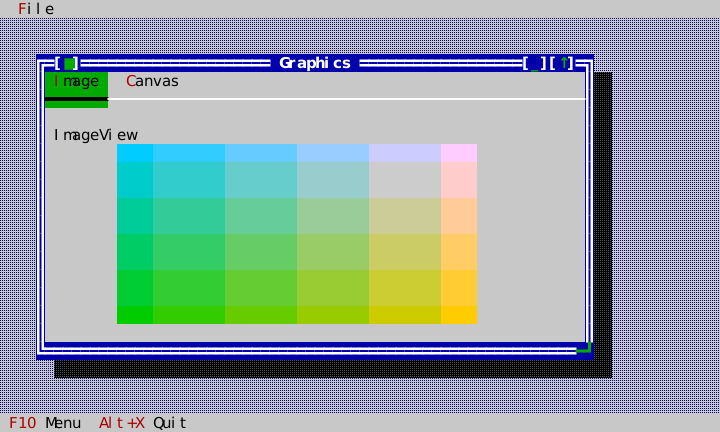 | 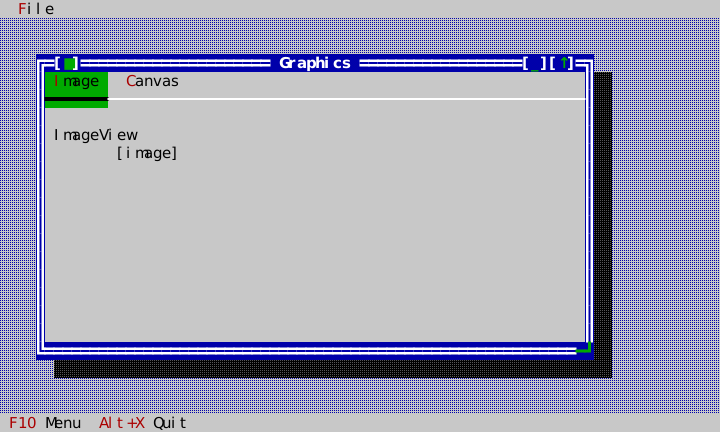 |
The same app gives each view a click callback and switches pages through a
normal TabControl:
    auto status = std::make_unique<widgets::StatusLine>();
    status->set_items({widgets::StatusLineItem{widgets::CommandPresentation{app_.commands().standard().menu}},
                       widgets::StatusLineItem{widgets::CommandPresentation{app_.commands().standard().quit}}});
    desktop_->dock_bottom(std::move(status));
}

void GraphicsApp::build_window() {
    demo_image_ = make_demo_image();

    auto window = std::make_unique<widgets::Window>("Graphics");
    window->set_bounds(Rect{4, 3, 62, 17});
    auto tabs = std::make_unique<widgets::TabControl>();
    tabs->set_bounds(Rect{0, 0, 60, 15});
    tabs_ = tabs.get();

    auto image_page = std::make_unique<ui::View>();

    auto image_label = std::make_unique<widgets::Label>("ImageView");
    image_label->set_bounds(Rect{1, 1, 16, 1});
    image_page->add_child(std::move(image_label));

    auto image = std::make_unique<widgets::ImageView>();
    image->set_bounds(Rect{1, 2, 54, 10});
    image->set_image(demo_image_);
    // Every event carries the cell and, where the terminal reports pixels,
    // the pixel position; the view maps the latter into the picture.
    image->on_click = [this](const MouseEvent& event) {
        ++image_clicks_;
        last_image_pointer_ = PointerReport{event, image_view_->image_pixel_at(event)};
    };
    image_view_ = image.get();
    image_page->add_child(std::move(image));

    auto canvas_page = std::make_unique<ui::View>();

    auto canvas_label = std::make_unique<widgets::Label>("Canvas");
    canvas_label->set_bounds(Rect{1, 1, 16, 1});
    canvas_page->add_child(std::move(canvas_label));

    auto canvas = std::make_unique<widgets::Canvas>();
    canvas->set_bounds(Rect{1, 2, 54, 10});
    canvas->set_cell_metrics(PixelSize{2, 3});
    canvas->set_draw_callback([](Image& target) {
        for (int y = 0; y < target.height(); ++y) {
            for (int x = 0; x < target.width(); ++x) {
                const bool stripe = ((x / 4) + (y / 4)) % 2 == 0;
                target.set_pixel(x, y,
                                 Image::Rgba{stripe ? std::uint8_t{240} : std::uint8_t{40},
                                             std::uint8_t(x * 255 / (target.width() > 1 ? target.width() - 1 : 1)),
                                             std::uint8_t(y * 255 / (target.height() > 1 ? target.height() - 1 : 1)),
                                             255});
            }
        }
    });
    canvas->on_click = [this](const MouseEvent& event) {
        ++canvas_clicks_;
        last_canvas_pointer_ = PointerReport{event, canvas_->image_pixel_at(event)};
    };
    canvas_ = canvas.get();
    canvas_page->add_child(std::move(canvas));

    auto note = std::make_unique<widgets::StaticText>(
        "Run with Sixel or NoGraphics terminal profiles to see raster output and fallback.");
| Sixel Canvas | No-graphics Canvas |
|---|---|
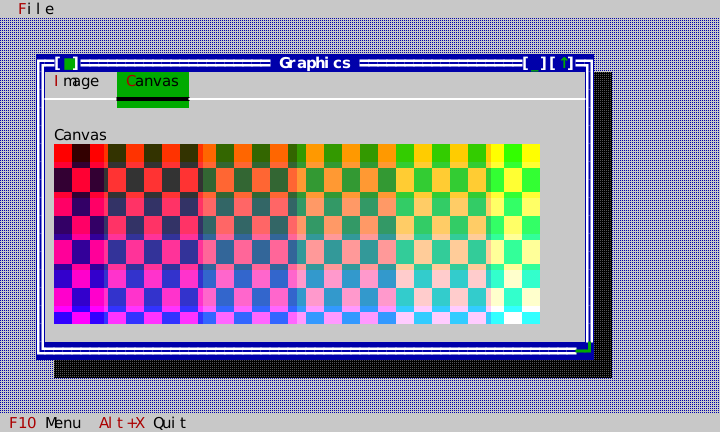 | 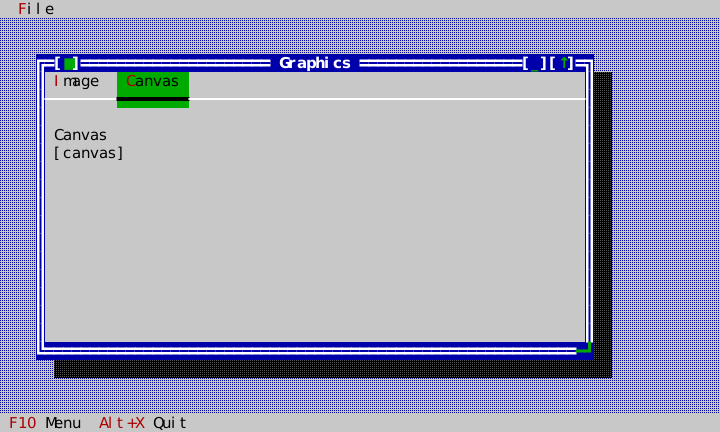 |
For a Canvas, set cell metrics before drawing so cell and raster geometry agree.
The callback receives its target image; do not bypass the view to write terminal
protocol directly. Mouse events reach on_click; pixel coordinates are
available only when the injected terminal capability advertises pixel mouse.
Every event carries its cell, and its pixel position within the terminal's text
area whenever the terminal reports pixels (SGR-Pixels). To know which pixel of
the picture the pointer is on, ask the view: ImageView::image_pixel_at(event)
maps the reported pixel through the image's centred anchor and the terminal's
cell metric, and Canvas::image_pixel_at(event) maps it onto the backing image
the canvas fills — sized by set_cell_metrics(), but shown over the terminal's
own cells. Both are MouseEvent::image_pixel(area, cell_pixels, image_pixels)
for the view's geometry, which an application drawing a picture of its own calls
directly. The answer is the source pixel the presenter samples at that screen
pixel, so what the reader points at and what the application hit-tests agree.
It is empty when the terminal reported cells only — a picture pixel is never
estimated from a cell — and when the pointer is beside the picture. The Graphics
example records both coordinate spaces and the mapped pixel for every event its
two views receive, and its smoke suite drives them with SGR-Pixels reports
through a HeadlessTerminal whose profile has pixel_mouse set.
The HeadlessTerminal captures above test both Sixel and no-graphics profiles
through Presenter bytes and a virtual display, rather than reading image memory.
Scrolling and occlusion
A picture inside something that scrolls is not scrolled by the terminal. The scrolling view repaints what it shows, and draws the picture again at its new anchor — which may begin above the first row in view — clipped to what is visible (the decision log D-081). The compositor then cuts it around whatever covers it, and the Presenter encodes the result like any picture that moved. No terminal scroll region is involved: terminals disagree about whether a Sixel picture moves with the text around it, so the picture would be sent again anyway. Nothing is ever cut out of the picture itself; each row keeps its pixels as it moves, because the Presenter samples every slice in the whole picture's coordinates.
Two views scroll pictures this way. An ImageView taller than its space goes
in a ScrollViewport, which the Gallery's Sixel Demo window does:
// The picture is taller than the window, so it lives in a viewport: the
// wheel over it, or Up, Down, PageUp and PageDown once the viewport has
// the focus, move it a row or a page at a time. Nothing inside a picture
// can take the focus, so the viewport itself is the tab stop, and it
// scrolls only vertically, since a picture cut off at the side is not
// one a reader can scroll back to.
auto viewport = std::make_unique<widgets::ScrollViewport>(ui::FocusPolicy::TabStop);
viewport->set_horizontal_scrollbar_policy(widgets::ScrollbarPolicy::Hidden);
viewport->set_bounds(Rect{0, 0, 32, 14});

// 62 x 112 pixels over 31 columns is 28 rows on a terminal whose cells
// are twice as tall as they are wide; ImageView keeps the proportions
// on any other cell and centres the picture in the rows it was given.
auto view = std::make_unique<widgets::ImageView>();
view->set_role_override(roles_.dialog_background);
view->set_preferred_size(Size{31, 28});
view->set_image(make_demo_gradient());
image_view_ = view.get();
viewport->set_content(std::move(view));
picture_viewport_ = viewport.get();
window->set_content(std::move(viewport));
ImageView and Canvas consume every mouse event except the wheel, so a
wheel notch over the picture reaches the viewport around it. A FlowView
scrolls its inline pictures itself, by the same rule: a FlowImage is drawn
at its row less the rows scrolled, and clipped to the rows in view and the
columns left of the scrollbar.
The Gallery is the image demo that shows all of it. Scroll its picture with the wheel or, once a click has focused the viewport, with PageDown, and open View → Scheme across its top rows: the picture is cut around the menu and dimmed under the menu's shadow, and closing the menu puts back exactly the frame it opened over.
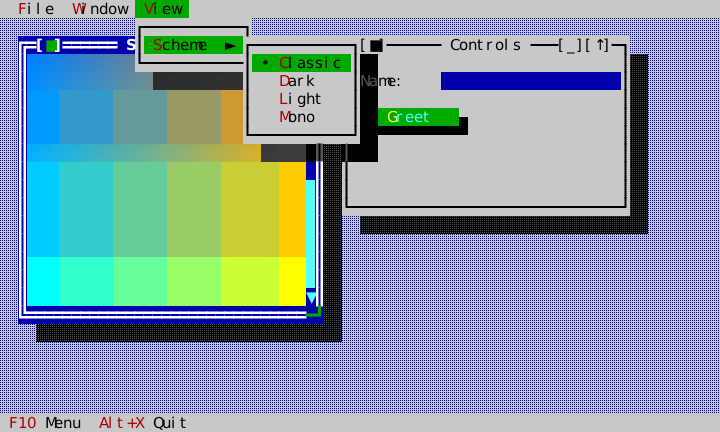
What proves it is two event scripts, each played on a fixed-metric Sixel profile and on NoGraphics in lockstep, whose every step is pinned four ways: the symbolic scene, which both profiles compose byte for byte; the cells and the RGBA pixel plane decoded from the Sixel run's bytes; and the cells decoded from the NoGraphics run, which hold the cell fallback and no pixel (golden format).
tools/docgen/raster_scroll_script.hppscrolls a picture in aScrollViewportby the wheel and a picture inline in aFlowViewby the arrow keys, one row and then three more (tests/golden/raster_scroll_*,tests/test_raster_scroll_golden.cpp).tools/docgen/gallery_script.hppplays the Gallery's image demo: a row by the wheel, a page by PageDown, the menu over the picture, and the menu closed (tests/golden/gallery_picture_*,tests/test_gallery_visual_golden.cpp).
Their tests ask the decoded planes what a reader would see go wrong. Each picture's anchor moves by exactly the rows scrolled and its visible part is its anchor cut at the view's edge; every pixel it shows in a later frame is the same pixel it showed in the earlier one, moved by that many rows; no pixel is left where no picture is and no hole where one is; under the menu there is no pixel, and under its shadow a darker one.
The symbolic scene records each visible slice by the part of the picture it shows, so a picture scrolled under a fixed clip changes its record even though its cells stay where they were.
Animated raster content
A picture that changes needs four things a still one does not: somewhere to render it that is not the owning thread, a way back into the application that does not touch the view tree from outside, a redraw that costs one view rather than one screen, and a frame rate that yields to the reader when the loop is busy. The Spin example is the reference for all four.
Publishing a frame
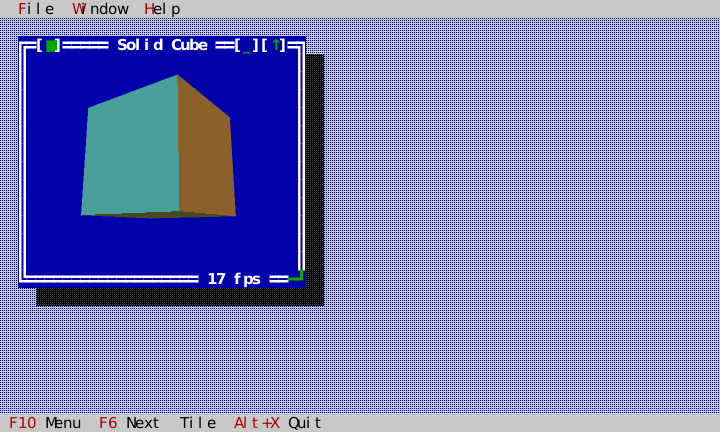
SpinView is the whole of the application-side contract:
void SpinView::request_frame(RenderService& service, std::int64_t now_nanos) {
    // The back-pressure, and the whole of it: while a frame is being
    // rendered this view asks for nothing. Ticks are opportunities, not
    // obligations.
    if (in_flight_) return;
    const ui::Application* const app = context().app;
    if (app == nullptr) return;
    const PixelSize pixels = target_pixels();
    if (pixels.width <= 0 || pixels.height <= 0) return;

    adopt_surface_role();

    FrameSpec spec;
    spec.pixels = pixels;
    spec.background = surface_color();
    // Angles come from the clock, so a frame that took too long leaves a
    // gap in the animation rather than slowing the rotation down.
    const double seconds = static_cast<double>(now_nanos - phase_nanos_) * 1e-9;
    spec.yaw = seconds * kYawRateRadiansPerSecond;
    spec.pitch = seconds * kPitchRateRadiansPerSecond;
    const int registers = app->terminal_capabilities().sixel_color_registers;
    spec.color_budget = registers > 0 ? registers : 256;

    in_flight_ = true;
    service.submit(shape_, spec, lifetime_token(),
                   [this](std::shared_ptr<const Image> frame) { accept_frame(std::move(frame)); });
}

double SpinView::frames_per_second() const noexcept {
    return smoothed_interval_seconds_ > 0.0 ? 1.0 / smoothed_interval_seconds_ : 0.0;
}

void SpinView::accept_frame(std::shared_ptr<const Image> frame) {
    in_flight_ = false;
    if (frame == nullptr) return;
    frame_pixels_ = frame->size();
    ++frames_shown_;

    // Measuring the rate is what an unattached view cannot do; showing the
    // frame is not. Publishing comes first for that reason — a frame is
    // never withheld because something about the readout was unavailable.
    if (context().app != nullptr) {
        const std::int64_t now = context().app->clock().now_nanos();
        if (last_frame_nanos_ && now > *last_frame_nanos_) {
            const double interval = static_cast<double>(now - *last_frame_nanos_) * 1e-9;
            // Smoothed rather than instantaneous: the rate is there to be
            // read, and a readout flickering between 9 and 21 says less
            // than a steady 15 does.
            smoothed_interval_seconds_ = smoothed_interval_seconds_ > 0.0
                                             ? smoothed_interval_seconds_ * 0.75 + interval * 0.25
                                             : interval;
        }
        last_frame_nanos_ = now;
    }

    // One call, and the framework does the rest: this view is invalidated,
    // its window repaints its own backing store, and the Presenter
    // re-encodes exactly one raster region.
    set_image(std::move(frame));
    // Anything showing a number about this animation is repainted with the
    // frame it describes, in the same batch and therefore in the same
    // presented frame — never on a clock of its own.
    if (on_frame_shown) on_frame_shown();
}
One frame in flight. The first line is the back-pressure, and the only
back-pressure there is. A tick that arrives while a frame is still rendering
asks for nothing, so the render queue is bounded by the number of animated
views however slow the host is. Angles come from the injected Clock rather
than from a frame counter, so a skipped frame leaves a gap in the animation
instead of slowing the rotation down.
The size is the view's own. bounds() in cells converted to a PixelSize
through Application::terminal_cell_pixels() with term::cells_to_pixels is a
picture that lands on whole cells at its true proportions — the same reasoning Canvas applies to its own backing
image, including falling back to widgets::kAssumedCellPixels when a terminal
draws pictures but never measured a cell. A resized window simply produces the
next frame at the new size.
The background belongs to the window. Sixel carries no alpha channel, so a
frame that does not bring its surroundings with it arrives as a rectangle of
some other color pasted over the window. Resolving the window's own frame role
through resolved_color — and setting that same role as the view's fallback
override — is what makes the picture end where the window's cells carry on, in
every theme, and on a terminal that shows the cell fallback instead.
The redraw is one call. set_image invalidates this view; the window
repaints its own backing store, the compositor touches the cells that changed,
and Presenter re-encodes one raster region. An animated view never needs
invalidate_all.
Two further constraints belong to the host rather than to the view, and an application that renders its own rasters has to respect both.
Colors. encode_sixel reproduces colors exactly while it has a register per
color, and otherwise quantizes the whole image — background included — to a
fixed color cube. A frame whose palette exceeds the host's reported
sixel_color_registers therefore loses the very background match the seam
depends on, which is why Spin's renderer builds each frame from a bounded color
table instead of shading freely.
Size. A terminal may answer XTSMGRAPHICS with a maximum Sixel geometry —
Capabilities::sixel_max_geometry, commonly 1000×1000 px. An image larger than
that is not clipped and not scaled: Presenter refuses it, and the view shows its
cell fallback where a picture should be. The limit applies to the image handed
over, not to the cells it occupies, so the answer is to render within it and let
the term layer scale the smaller picture back across the whole cell box —
SpinView::target_pixels() does exactly that, and gives up sharpness rather
than the picture. This is the failure worth knowing about by name: a window that
was showing a picture stops as soon as it is resized past the host's limit.
Diagnosing a missing picture. Give the application a graphics trace:
Application::set_graphics_trace(GraphicsTrace{sink, &clock}) makes Presenter
report every frame's raster traffic — including, on the frame it happens, why a
picture the scene placed did not reach the terminal ("this host reports no Sixel
graphics", or the image size against the stated maximum) — and every terminal
session the application owns report what its child asked about graphics and
which pictures decoded. term::FileTraceSink writes such a trace to a file or
standard error as it happens, and PosixTerminal::set_graphics_trace() adds the
backend's own summary of what the host supports. The library reads no
environment variable for this; the examples switch it on from
CKVISION_GRAPHICS_LOG in their own main()
(examples/example_diagnostics.hpp). term::capability_report() prints the same facts as a table an
application can show or a user can paste into a bug report; Spin's own About box
states them in a sentence.
A readout on the frame border
Window::add_frame_overlay puts a small view on a border row — the mechanism
behind widgets::EditorWindow's own "Ln 1, Col 1" indicator. Spin uses it for
a frame-rate readout in the bottom-right corner, and it is worth copying for
any value that changes as often as the content does:
- It pulls its text in
draw()instead of being handed a new string whenever the value changes. A pushedset_text()per frame is a size-hint change, and every one of those makes the window re-lay-out its overlays — a layout pass to display a number that is about to change again. - Its width is fixed, so that re-layout never happens and a number gaining a digit cannot shuffle the readout along the border. The text is right-aligned inside that box.
- It draws in its window's own frame role, active or inactive, so the border reads as one line with a number set into it.
- It is invalidated by the frame it describes —
SpinView::on_frame_shownfires immediately afterset_image— so both land in the same batch, and therefore in the same presented frame. A readout on a timer of its own would instead wake the loop on its own schedule to repaint eight cells.
Pacing, and staying responsive
An animation that always asks for the same frame rate makes the terminal's worst case its normal case. Everything an animated raster costs the OWNING thread — composing the damaged cells, scaling the image to the cell box, encoding the Sixel, writing it — grows with the window, and a maximized window full of raster can cost more per frame than the interval it was asked for. The loop then never catches up, and what the reader notices is not a slow animation but a slow application.
Spin answers that with two rules and no polling at all:
    last_tick_nanos_.reset();
}

void SpinApp::arm_next_tick() {
    // Self-clocking, and the reason this is a one-shot rather than a
    // repeating timer: the next tick is scheduled once the previous one
    // has run, so the loop cannot accumulate a backlog of ticks it owes
    // while it was busy. A repeating timer reschedules from its own fire
    // time and would deliver that backlog all at once afterwards.
    if (panels_.empty() || timer_) return;
    timer_ = app_.start_timer(interval_nanos_, /*repeating=*/false, [this] { tick(); });
}

void SpinApp::pace(std::int64_t now_nanos) {
    const std::int64_t observed = now_nanos - *last_tick_nanos_;
    last_tick_nanos_ = now_nanos;
    if (observed <= 0) return;

    if (observed > interval_nanos_ * 3 / 2) {
        // The loop is running late, and the only honest response is to ask
        // for less. Asking at the rate it is actually managing leaves
        // everything it was busy with — keystrokes, a window drag, a large
        // raster to encode — the room it was already taking.
        interval_nanos_ = std::min(kSlowestFrameIntervalNanos, observed);
    } else if (observed >= interval_nanos_ * 3 / 4) {
        // On time: ease back towards the target, geometrically rather than
        // at once, so one quiet tick after a busy stretch does not put the
        // load straight back.
        interval_nanos_ = std::max(target_interval_nanos_, interval_nanos_ * 7 / 8);
    }
    // And never faster than the terminal can paint what is already on it.
    // A loop that is keeping up perfectly says nothing about a decoder that
    // is not, because nothing in the protocol reports a picture drawn.
    interval_nanos_ = std::max(interval_nanos_, raster_paced_interval_nanos());
    // Anything much EARLIER than asked for is not a measurement of the
    // loop's health at all — it is a clock that jumped, or a host that
The timer is a one-shot that arms the next one after it has run, so the loop can never owe a backlog of ticks: a repeating timer reschedules from its own fire time, and after a stall it comes due once per missed interval, all at once. And the interval follows the loop: a tick that arrives much later than it asked for is the loop reporting that it had something better to do, so the next one is asked for at the rate the loop is actually managing, down to a documented floor. Ticks landing on time again ease it back geometrically. The cost of an overloaded moment is therefore a slower rotation, never an unresponsive window.
Knowing the terminal took it
Writing a frame proves its bytes left this side, and nothing more. A terminal that accepts them faster than it draws them lets an application produce frames nobody will ever see — the picture on screen falls further behind every one of them, and what the reader notices is an application that has stopped answering.
Application::set_frame_completion_tracking(true) closes that loop. Each
presented frame carries a Device Status Report after it; a terminal reads its
input in order, so its CSI 0 n reply says that frame has been taken in.
Nothing blocks — frames_awaiting_terminal() is a fact to consult, like the
cost counters beside it, and last_terminal_round_trip_nanos() says how long
the answer took.
The application loop also uses that answer as bounded back-pressure for
frames expensive enough to create a stale queue: every raster frame and every
text frame of at least term::kLargeTextFrameBytes (4 KiB) must finish before
another frame is sent. Input and retained scene state continue to update; only
the latest dirty state survives, so a rapid window drag sends the current
position after the host catches up rather than every position crossed on the
way. Text below the threshold remains immediate. This applies only after a
host has answered once, so a terminal without DSR replies never acquires a
periodic stall from a facility it does not implement.
What that reply is worth. More than the protocol promises, and less than it looks. On a host examined for this (iTerm2), Sixel is decoded by a blocking call inline on the same path that answers the status report, so the reply is ordered after the picture in front of it has been decoded and applied to the screen model — real back-pressure against the decoder, which is the expensive part. It still says nothing about presentation: drawing happens afterwards, on the host's own schedule. An application that paces on the reply ALONE therefore runs at the host's decode-saturation rate — which is, on the host measured, also the rate at which its renderer visibly starts losing pictures to replacement races. Use the reply as a brake, never as permission: Spin keeps its raster pixel-rate budget in charge and lets the reply only slow things further.
Waiting is the point. A host that has answered once must be waited for
however slowly it answers afterwards — a decoder taking half a second over a
full-screen picture is not a host without the facility, and writing its answer
off removes the very back-pressure that was keeping the picture whole. That is
why the deadline stretches to a multiple of the slowest answer a host has
shown (kFrameCompletionPatienceFactor), and why only a terminal that has
never answered is concluded not to implement the query.
While a window is being dragged or resized, every window's pictures are
left out — not only the moved window's. A moving occluder re-slices whatever
it passes over, and each slice is a replacement the host pays to decode, so
one gesture rests the whole desktop's pictures and the drop brings them back
at once. Window suspends them for the duration of the gesture
(scene::Surface::set_rasters_suppressed) and brings them back where the
gesture ended — a picture per pointer report is a decode per position for
pixels that are wrong before they are drawn, and a window whose content is
text pays nothing for this because there is nothing to suspend. The reader
sees the widget's own fallback while the window moves, and the picture once
it lands.
Where no reply comes, an application has to guess, and the only useful currency is raster pixels per second — the cost is in decoding pixels, not in transmitting bytes, so a compact run-length-encoded picture is not a cheap one. Spin carries such a budget, and keeps it in charge even where the reply arrives — see above for why the reply must not become permission.
An application then gives the terminal the same one-deep rule it gives its renderer, which in Spin is one line in the tick:
if (app_.frames_awaiting_terminal() == 0)
    for (const Panel& panel : panels_) panel.view->request_frame(frames_, now);
arm_next_tick();
A terminal that never answers must not stall anything, so an unanswered frame
is written off after kFrameCompletionTimeoutNanos, and a host that misses
kFrameCompletionGiveUpCount in a row is taken at its word: tracking turns
itself off, a diagnostic records it, and pacing falls back to tick lateness. An
absent optional reply is never evidence of a missing capability.
Asking obliges you to stay for the answer. A session that stops reading
with a question outstanding does not cancel the reply: restoring a terminal
hands its input queue on rather than emptying it, so CSI 0 n is delivered to
whatever reads next. In an ordinary session that is the shell, which discards
ESC [ 0 as an unknown key sequence and shows the trailing n as typed input
— one stray character at the prompt for the last frame nobody waited for.
~Application therefore calls Application::settle_frame_completion() before
it restores; a host that hands the terminal back while the Application lives
on calls it itself. It waits only on a host that has answered before, only as
long as that host's own slowest answer suggests it needs, and drops whatever
else arrives meanwhile — the session's reading is over, and there is nothing
left to deliver it to.
It is off by default. It adds bytes to the presented stream, and a byte-exact golden is entitled to the frame it asked for and nothing else.
The other signals available for pacing are Clock (how late a tick was) plus
Application::last_compose_cells_touched() and
Application::last_bytes_emitted().
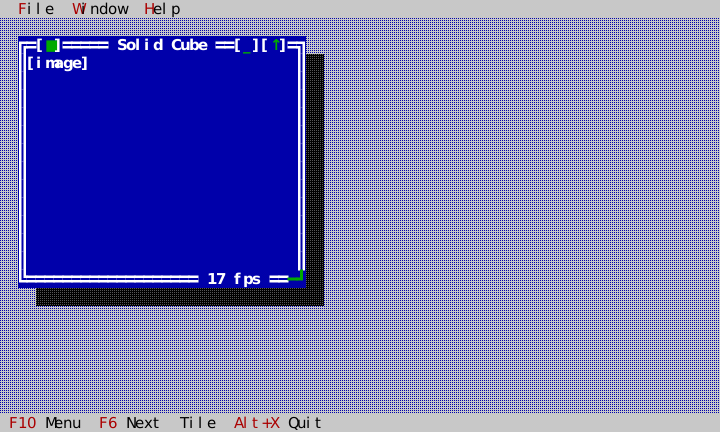
| Sixel Spin | No-graphics Spin |
|---|---|
 |  |