 CK Core Apps
System Load (ck-load)
ck-load (LoadMeters X application class, window title System Load) monitors real-time Linux CPU utilization, physical memory, swap usage, and 1-, 5-, and 15-minute load averages using six segmented 3D Motif meters (VerticalMeter).
| Main window | Live desktop icon |
|---|---|
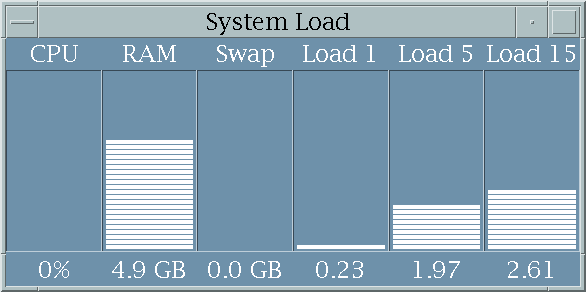 |  |
Monitored metrics
Updated once per second (1000 ms) from Linux /proc:
| Column | Source | Readout format | Scaling behavior |
|---|---|---|---|
| CPU | /proc/stat (user, nice, system, idle, iowait, irq, softirq, steal deltas) | <N>% | 0–100% |
| RAM | /proc/meminfo (MemTotal - MemAvailable) | <X.Y> GB | 0–MemTotal |
| Swap | /proc/meminfo (SwapTotal - SwapFree) | <X.Y> GB | 0–SwapTotal |
| Load 1 / 5 / 15 | /proc/loadavg normalized by sysconf(_SC_NPROCESSORS_ONLN) | Raw load (0.00) | 1.0 per online CPU core = 100%; if any load exceeds 100%, all three load meters scale together and draw cells above 100% as outlined segments |
Dynamic icon and sticky label geometry
ck-load integrates closely with CK Core CDE's dtwm window manager (<Dt/WmSettings.h>):
- On-demand rendering: Tracks both
WM_STATE(IconicState) and_DT_WM_SETTINGS_V1(DT_WM_SETTINGS_V1_SHOW_OPEN_WINDOW_ICONS), rendering its dual-bar CPU / RAM icon pixmap only when the window is minimized or open-window desktop icons are enabled. - Responsive sizing: Queries
WM_ICON_SIZE(32×32,48×48,64×64,96×96) and adjusts bar contrast automatically against the current Motif palette. - Non-jittering icon label (
icon_label_state.c): Measures"CPU <N>%"in the actual Motif label font against the icon width. If a wider value (such asCPU 100%) overflows a narrow icon (32×32),ck-loadlatches to compact<N>%labels and keeps that form untildtwmadvertises a new icon size—verified by unit testtests/ck_load_icon_label_state_test.c(make check).
See High-resolution dynamic icons for rendered icon comparisons.
Command-line options and session state
ck-load [-session <session_id>] [Xt options...]
- CDE session state: Saves and restores window position and dimensions (
x,y,w,h) viaDtSessionSavePath/DtSessionRestorePath.